
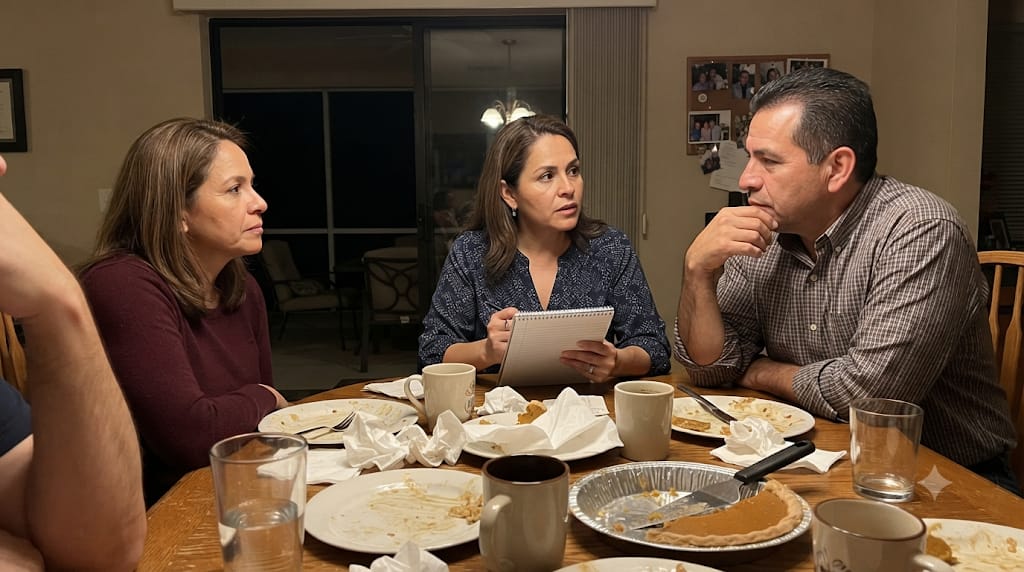
The short answer: Sort out three things before anyone argues about money: who has legal authority to make your parent's health and financial decisions, who will sign the facility contract and how, and how the bill gets split. In Florida, a health care surrogate named in writing decides health questions. If nobody was named, a spouse comes first and then a majority of the adult children who are reasonably available. Money decisions need a durable power of attorney, because no one gets them automatically. For taxes, siblings who together pay more than half of a parent's support can agree each year which one claims the parent as a dependent. If the holidays are when your family is finally in one room, use the time to agree on a written plan, and include your parent. This is general information, not legal or tax advice.
Who has the legal authority to decide?
Start here, because the answer shapes everything else. Florida separates health decisions from money decisions, and different documents cover each.
| Decision | Who decides | Florida law |
|---|---|---|
| Health care, including moving into assisted living | The health care surrogate your parent named in writing, or a backup if the first can't serve | s. 765.202, s. 765.205 |
| Health care, if no surrogate was named | A proxy: a guardian, then the spouse, then a majority of the adult children who are reasonably available | s. 765.401 |
| Bank accounts, bills, property | The agent named in a durable power of attorney | s. 709.2105 |
| Everything, if no documents exist and your parent can't decide | A court-appointed guardian | ch. 744 |
While your parent can still make decisions, they make them. Florida's suggested surrogate form says so plainly: "While I have decisionmaking capacity, my wishes are controlling" (s. 765.203).
A surrogate "may authorize the admission, discharge, or transfer" of a parent to or from a facility licensed under chapter 429, the assisted living chapter, and can apply for Medicare and Medicaid on their behalf (s. 765.205). The law is built around one surrogate plus an alternate, not a committee. The other siblings can still be kept informed: since 2024, Florida law has recognized a "supported decisionmaking agreement" that lets someone receive information, including medical records, and communicate for your parent without any power to act (s. 709.2209).
If nobody was named, health decisions go down a list. A living, capable spouse comes before the children. After that, it's "a majority of the adult children who are reasonably available for consultation" (s. 765.401). "Reasonably available" means "readily able to be contacted without undue effort and willing and able to act in a timely manner" (s. 765.101). A sibling who can't be reached in time doesn't count toward the majority. A proxy decides health care only, never money.
One surprise for families with a power of attorney: in Florida, naming two siblings as co-agents does not make them act together. "Unless the power of attorney otherwise provides, each co-agent may exercise its authority independently" (s. 709.2111). If you want two signatures on big decisions, the document has to say so. Our guide to powers of attorney and health care surrogates explains how to set these up, including documents signed in another state.
What happens when siblings disagree?
Florida gives you two ways to go to court before relationships break down for good:
- Health decisions. Family members can seek "expedited judicial intervention" if they believe a surrogate's or proxy's decision isn't what the parent wanted or doesn't follow the law, or if the surrogate has abused their powers (s. 765.105).
- Money. Any interested person who has a good-faith belief that intervention is needed can ask a court to "review the agent's conduct" and remove an agent (s. 709.2116).
Siblings who aren't agents have no automatic right to see the agent's records. The agent "is not required to disclose receipts, disbursements, transactions" unless the power of attorney says so, a court orders it, or another fiduciary asks (s. 709.2114). The agent does have to keep those records, and the Consumer Financial Protection Bureau suggests letting another family member see them "as a precaution" (CFPB guide for agents). The simplest fix is to agree that the agent sends everyone a short statement every quarter.
Guardianship is the last resort. Florida says it is "only warranted when no less restrictive alternative," such as a durable power of attorney or a health care surrogate, is available (Florida Courts). The fees are paid from your parent's property, and a guardian of property must file a report with the court every year (s. 744.331; s. 744.367). A son or daughter who lives in another state can still serve as a parent's guardian (s. 744.309).
How do siblings split the cost fairly?
Spend your parent's money first. Income, savings and the proceeds of a home sale usually come before anyone's paycheck, and some programs only help once your parent's money is low. Our guide to how to pay for assisted living in Florida covers the options, and our cost breakdown shows what a monthly bill includes. Budget for the bill to rise: our guide to rate increases explains how much notice facilities must give.
"Fair" rarely means equal. The sibling who lives 15 minutes away is giving hours each week. A sibling three states away might put in more money instead, or cover flights, or take the paperwork. Write down what each person gives, in money and in time, and look at it again every six months.
If one sibling will be paid for caregiving, put it in writing. That pay is taxable income for the sibling who receives it (IRS). It also matters if your parent may need Medicaid later. Florida's Department of Children and Families lists a "personal services or care contract" as a clue to a possible transfer of assets, and asks for an agreement showing "the type, frequency, and duration" of the care, along with its value. It looks back 60 months (DCF policy manual). Our Medicaid guide explains the rest.
Who gets the tax break?
When no single sibling pays more than half of a parent's support, but together you do, you can agree that one of you claims the parent as a dependent. That person must pay more than 10% of the support, and "each of the others must sign a statement agreeing not to claim the person as a dependent for that year" (IRS Publication 501). The statement is Form 2120, the Multiple Support Declaration. Keep it with your records rather than filing it (Form 2120).
The IRS's own example uses four siblings who pay 45%, 35%, 10% and 10%. Either of the first two can claim the parent. Neither of the 10% siblings can, because the test is more than 10% (IRS Publication 501). The agreement covers one calendar year, so many families take turns.
Four rules trip families up:
- Your parent's own money counts. Total support includes Social Security, savings and other money your parent spends on themselves. If your parent pays most of the bill, the siblings may not reach the "more than half" mark, and then no one can claim them (IRS Publication 501).
- The income limit. To be claimed as a dependent, a parent's gross income must be under $5,200 for 2025 and $5,300 for 2026 (Rev. Proc. 2025-32). Only the taxable part of Social Security counts toward it.
- Only the sibling who claims your parent deducts medical costs. Medical expenses paid by the others "can't be included as medical expenses by anyone," and if they pay you back, your deduction shrinks. The IRS's own fix: the other siblings pay for non-medical items, and the claiming sibling pays the medical bills (IRS Publication 502).
- No head-of-household status through the agreement. If you can claim your parent only because of a multiple support agreement, they aren't a qualifying person for head of household (IRS Publication 501).
How much of an assisted living bill counts as a medical expense is its own question. Our guide to whether assisted living is tax deductible covers it. Florida has no state income tax, so these are all federal rules.
Who should sign the facility contract?
Florida law says the contract is between the facility and "the resident or his or her designee or legal representative" (s. 429.24). Facility paperwork often has a line for a "responsible party." Florida's assisted living law uses that phrase but never defines it, and we found no Florida statute or rule on whether a facility may ask an adult child to guarantee payment.
Nursing homes are different. Federal rules say a nursing home "must not request or require a third party guarantee of payment" as a condition of admission (42 CFR 483.15). That rule doesn't cover assisted living.
So read the signature block before anyone signs. If it says "guarantor" or "responsible party," ask the facility in writing what it means for you personally. If you're signing under a power of attorney, sign as agent, in the form the Consumer Financial Protection Bureau suggests: your name, "as agent for" your parent's name (CFPB guide for agents). Our list of contract clauses to check before signing covers the rest of the paperwork.
Do adult children have to pay for a parent's care in Florida?
We could not find any Florida statute that makes adult children pay for a parent's assisted living. A search of the 2026 Florida Statutes for "filial," the legal term for these laws, returns nothing (Online Sunshine). What creates obligations is what you sign, and the legal duties you take on when you manage a parent's money as their agent.
Can the sibling doing the most get time off work?
The Family and Medical Leave Act gives eligible workers "up to 12 workweeks of leave in a 12-month period," unpaid but job-protected, including to care for "a parent who has a serious health condition." You must have worked for the employer for 12 months and 1,250 hours, at a site with at least 50 employees within 75 miles (U.S. Department of Labor). Parents-in-law don't count (U.S. Department of Labor).
The regulation covers making "arrangements for changes in care, such as transfer to a nursing home," and says the employee "need not be the only individual or family member available" to care for the parent. Leave can also be taken in pieces when "care responsibilities are shared with another member of the family" (29 CFR 825.124). Florida has no paid family leave program (U.S. Department of Labor). Siblings who work in other states should check their own state's rules.
How do you run the family meeting?
The National Institute on Aging says the conversation "will be most productive when there is not an emergency." It suggests including the older person and naming a primary caregiver, the one who handles most of the day-to-day (NIA). A Thanksgiving dinner table is not the place to spring a move on your parent. The weekend is fine for the siblings to meet first, then talk with your parent together. Our conversation scripts can help. If you're still not sure it's time, see the signs families notice.
A one-hour agenda:
- What does your parent want? Start there, and come back to it.
- What documents exist? Surrogate, power of attorney, will, insurance policies. Who has the originals?
- What does your parent have? Monthly income, savings, the house, long-term care insurance, veterans benefits.
- Who does what? NIA suggests matching tasks to strengths, such as asking "who is good with numbers?" to handle bills and statements. Siblings far away can research facilities, join care-plan calls by video, or fly in so the nearby sibling gets a break (NIA).
- Who pays what, and who claims the tax benefits?
- When do you meet again? Put a date on the calendar.
Write the plan down and send it to everyone. If your siblings are spread across the country, our guide to choosing Florida assisted living from out of state covers tours, contracts and visits from a distance. Our Florida directory lists 3,006 licensed facilities, so one sibling can build a shortlist before the meeting. If your parent already lives in assisted living and is joining you for the holiday, read our guide to taking a parent out for the holidays.
If the family gets stuck, outside help is available:
- A geriatric care manager can help families "discuss difficult topics and complex issues" and evaluate living arrangements. They charge by the hour, and Medicare and Medicaid don't pay for them (NIA).
- Florida's Elder Helpline, 1-800-963-5337, connects you with your local aging agency (Florida Department of Elder Affairs). The Florida Senior Legal Helpline, 1-888-895-7873, gives free legal advice by phone to residents 60 and older who meet its income guidelines (Elder Affairs).
- Veterans' families can call the VA Caregiver Support Line at 1-855-260-3274 (VA). Our Aid and Attendance guide covers the VA pension that can help pay for assisted living.