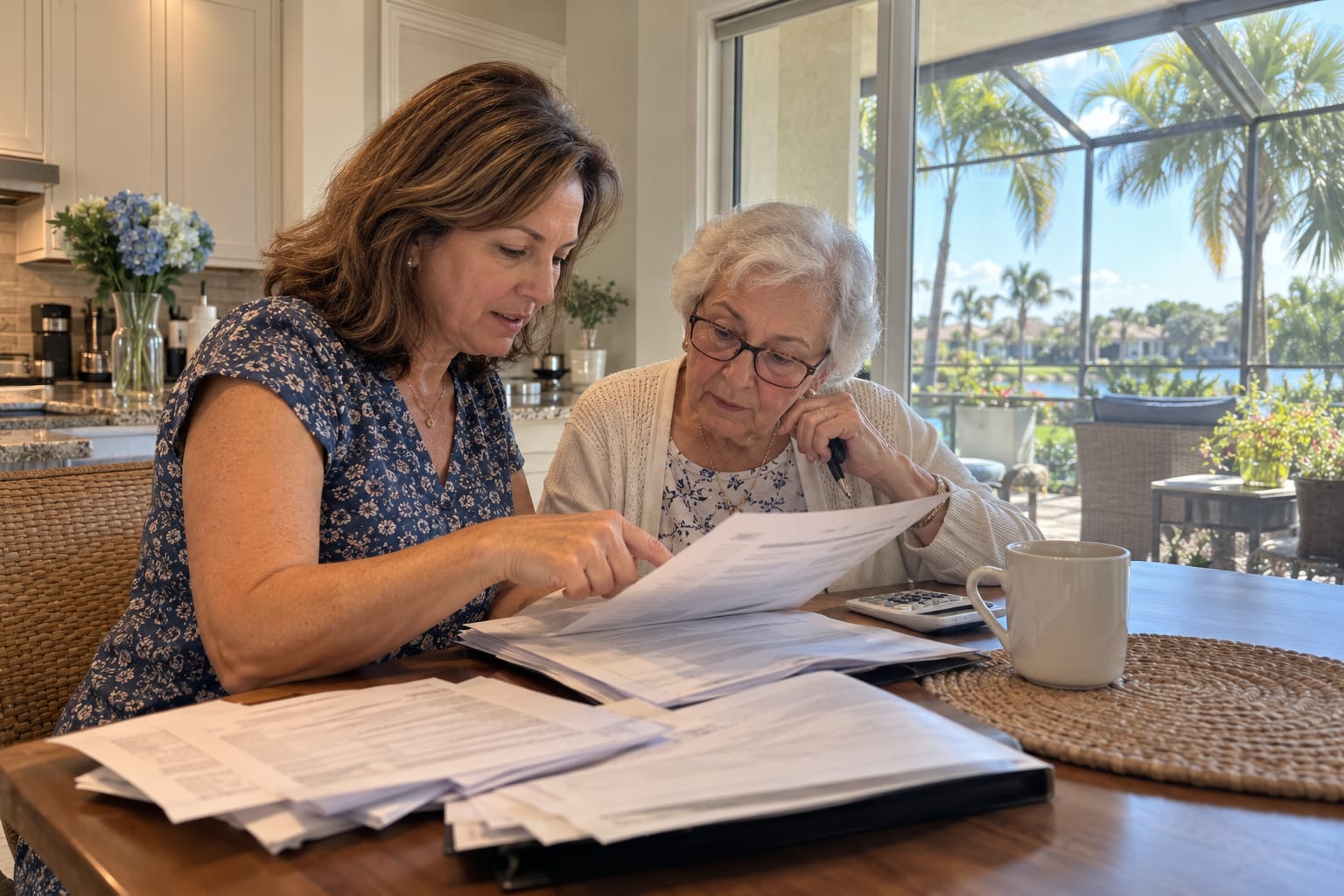

The short answer: Most Florida families pay for assisted living with a stack, not a single source — private savings and Social Security first, then VA pension benefits, long-term care insurance, or Florida's Medicaid Statewide Medicaid Managed Care Long-Term Care (SMMC-LTC) waiver. The catch nobody warns you about: SMMC-LTC is not an entitlement, so your parent can be medically eligible and still sit on a waitlist while the monthly bill keeps arriving. Florida publishes no statewide wait time, and waits can run months or considerably longer — that gap is what bridge loans, life insurance conversions, and home sale proceeds are for.
How much does assisted living really cost in Florida each month?
The national median cost of assisted living rose 5% to $6,200 per month, or $74,400 per year, in a Cost of Care Survey fielded July through November 2025, according to CareScout (Genworth). Florida pricing varies enormously by county — a small licensed home in Palm Bay and a full-service community in Boca Raton are not the same product — but the national median is the right planning anchor when you're building a budget.
Costs have been climbing fast. In the 2024 survey, assisted living jumped 10% to a national annual median of $70,800 while occupancy rose from 77% to 84%, tightening supply, per Genworth's press release. Assisted living costs climbed 18.9% between 2021 and 2023 alone, as Senior Housing News reported.
| Care setting | Recent national median | Source year |
|---|---|---|
| Assisted living | $6,200/month ($74,400/yr) | 2025 survey |
| Assisted living | $5,900/month ($70,800/yr) | 2024 survey |
| Nursing home, semi-private | $9,277/month ($111,325/yr) | 2024 survey |
| Nursing home, private room | $10,646/month ($127,750/yr) | 2024 survey |
| Home health aide | $34/hour ($77,792/yr) | 2024 survey |
Supply matters to price, and Florida has a lot of it. AssistedLivingFacility.com directory data tracks 3,006 licensed, active assisted living facilities across 54 Florida counties with a combined licensed capacity of 118,442 beds. Miami-Dade leads with 805 facilities, followed by Hillsborough (263), Broward (249), Palm Beach (199), and Pinellas (138) — so in most metros you have real negotiating room. Start with the Florida directory or a county page like Miami-Dade.
Which funding sources are permanent and which are only bridges?
Sort every option into two buckets before you make a single phone call. Permanent funding replaces income month after month. Bridge funding buys you time while a permanent source turns on.
| Option | Type | Typically covers | Time to start |
|---|---|---|---|
| Long-term care insurance | Permanent | Daily benefit toward care costs | Weeks to a few months after claim |
| SMMC-LTC Medicaid waiver | Permanent | Care services only — not room and board | No published wait time; months or longer |
| VA pension + Aid & Attendance | Permanent | Up to $2,424/mo (veteran alone), $2,874/mo (veteran with a spouse), or $1,558/mo (surviving spouse), base plus A&A, per MedicaidPlanningAssistance.org | Several months |
| Home sale proceeds | Bridge | Whole bill until spent | Weeks to months |
| Bridge loan / line of credit | Bridge | Monthly rent, repaid at closing | Weeks |
| Life insurance conversion | Bridge | Lump sum or monthly benefit account | Weeks to a couple of months |
| Family cost-sharing | Either | The gap nobody else covers | Immediate |
Does Florida Medicaid pay for assisted living rent?
No — and this is the single most expensive misunderstanding Florida families make. Florida Medicaid's long-term care waiver pays for services delivered inside an assisted living facility: personal care, medication management, case management, therapies. It does not pay the room-and-board portion of the rent. Your parent's Social Security and any pension income go toward that room and board, and the facility sets the room-and-board rate it will accept.
Florida's Long-Term Care Waiver is a capitated managed care program delivered through SMMC Long-Term Care plans and MMA Comprehensive plans. Enrollees must be age 65+ and need a nursing facility level of care, or age 18+ eligible for Medicaid by reason of disability and need a nursing facility level of care, per Florida's Agency for Health Care Administration. That level-of-care finding comes from a CARES assessment (Comprehensive Assessment and Review for Long-Term Care Services) conducted by the Department of Elder Affairs.
SMMC-LTC also goes by "the Medicaid Waiver" and "Home and Community Based Medicaid" — same program, three names, as Florida elder law firm Elder Needs Law explains.
How long is the SMMC-LTC waitlist, and how do you move up?
Unlike Nursing Home Medicaid, Florida's SMMC-LTC program is not an entitlement — it has a limited number of enrollment slots, reported at 128,750 for 2026, and the waitlist is managed by the Department of Elder Affairs and the Aging and Disability Resource Centers, prioritized by medical need and frailty rather than by date of application, according to MedicaidLongTermCare.org. Confirm current slot counts and screening rules directly with your regional ADRC, since they change.
What that means practically: you don't "move up" by waiting. You move up when your parent's documented frailty score rises. Three things actually help.
- Call your ADRC (Elder Helpline, 1-800-96-ELDER) and complete the 701S screening immediately — even before a move. The clock and the priority score both start there.
- Keep the file current. Report every hospitalization, fall, new diagnosis, or increase in help needed with bathing, dressing, transferring, and toileting. Frailty scoring is driven by documented ADL dependence.
- Apply for financial eligibility in parallel through DCF, so you're not starting the financial review after the slot is released.
Budget for a private-pay gap. A Florida sequence typically looks like: move-in and ADRC screening; CARES assessment and level-of-care determination; then an open-ended wait for a slot while paying privately; then enrollment and plan assignment. To size the risk, run the math on your own timeline — at the 2025 national median of $6,200/month, per CareScout, nine months of private pay is about $55,800, and that is the kind of number your bridge plan has to cover.
How much is VA Aid & Attendance worth toward assisted living?
For the benefit year December 1, 2025 through November 30, 2026, the VA Maximum Annual Pension Rate is $17,441/year ($1,453/month) for a veteran with no dependents, $22,839/year ($1,903/month) for a veteran with a spouse or dependent child, and $11,699/year ($974/month) for a surviving spouse with no dependent child, per MedicaidPlanningAssistance.org. Aid & Attendance is an add-on above those base rates. Verify current figures against the official VA pension rate tables on va.gov before you file.
The mechanic that wins Florida claims: countable income is reduced by unreimbursed medical expenses — and assisted living care costs generally count. That is how many veterans who look over-income on paper still qualify once the facility bill is applied.
Net worth (assets plus countable annual income) is capped at $163,699 for the December 2025–November 2026 rate year, with the primary residence, one vehicle, and basic household furnishings excluded; a three-year look-back penalty applies to below-market transfers, per this VA pension reference. Confirm the exact limit on va.gov.
What are the bridge options when savings run out this month?
Use bridge funding when a permanent source is approved-but-not-yet-paying, or when a house hasn't sold.
- Senior living bridge loans. Short-term lines of credit underwritten against a pending home sale or VA claim. Multiple adult children can co-borrow. They fund in weeks, not months — and they are expensive, so pair one with a firm exit date.
- Life insurance conversion. Instead of letting a policy lapse or surrendering it for cash value, a life settlement or long-term care benefit plan converts the death benefit into a monthly benefit account that pays the facility directly. Worth pricing on any policy your parent can no longer afford.
- Home sale proceeds. In Florida, the homestead is generally an exempt asset for Medicaid purposes while occupied or intended to be returned to — selling converts an exempt asset into countable cash. Talk to a Florida elder law attorney before listing, not after the closing.
- Family cost-sharing. Write it down. A one-page agreement stating who pays what, for how long, and whether contributions are gifts or loans prevents the sibling fight that derails care. Ask a CPA whether anyone's share qualifies as a deductible medical expense.
What happens if the money runs out while your parent is already in an ALF?
Talk to the administrator before the balance hits zero, not after. Florida ALFs are not required to accept Medicaid waiver residents, and not every community holds contracts with the SMMC-LTC managed care plans — so the first question on every tour should be: "Do you contract with SMMC Long-Term Care plans, and what room-and-board rate do you accept for waiver residents?"
If the answer is no, plan a move while you still have leverage and time. Communities in high-supply markets like Tampa and Miami are more likely to have waiver-contracted beds, and AssistedLivingFacility.com directory data shows Miami alone has 576 licensed facilities. Get the discharge-notice policy in writing at move-in so a 30-day letter is never a surprise.