The short answer: Yes, you can usually take a parent home from a Florida assisted living facility for Thanksgiving or Christmas. State rules say a resident "may travel independently in the community," and the bill of rights protects their freedom to take part in community life. The details are set by the facility's sign-out policy and your contract. Plan the medications first. Florida rules give four ways to send them with you, but only a nurse may fill a pill organizer, and aides can't repackage pills into envelopes. Don't expect a discount for days away unless your contract offers one. If your parent has dementia, keep the visit short and familiar.
Can a resident leave assisted living for a holiday visit?
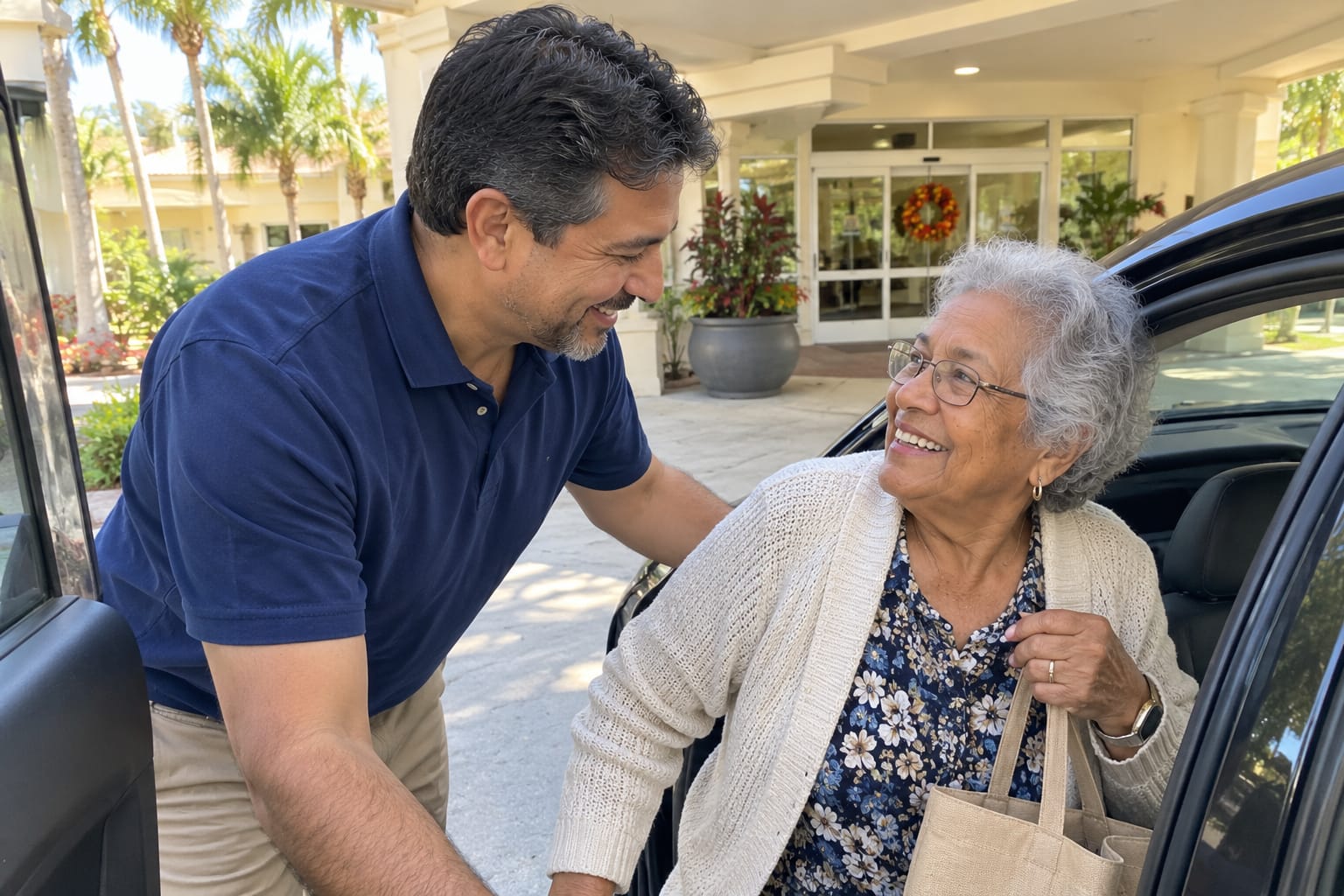
Florida's resident bill of rights protects "freedom to participate in and benefit from community services and activities and to pursue the highest possible level of independence, autonomy, and interaction within the community," and facilities "shall not hamper or prevent residents from exercising their rights" (s. 429.28, Florida Statutes). The supervision rule requires staff to keep "a general awareness of the resident's whereabouts" and adds: "The resident may travel independently in the community" (rule 59A-36.007).
Facilities can still set procedures. Florida defines elopement as a resident leaving "without following facility policy and procedures" (rule 59A-36.002), and house rules must cover it. In practice that means signing your parent out, saying when you'll be back, and leaving a phone number. Residents assessed as at risk of wandering get closer supervision: staff must "be generally aware of the location" of high-risk residents at all times, and those residents must carry identification with the facility's name and phone number (rule 59A-36.007). If a guardian or health care surrogate makes decisions for your parent, include them in the plan.
How do medications work when a parent leaves the facility?
Florida's medication rule lists four options "when a resident who receives assistance with medication is away from the facility and from facility staff" (rule 59A-36.008):
| Option | How it works | Good for |
|---|---|---|
| Adjust the schedule | The doctor times doses around when your parent is at the facility | An afternoon out |
| Take the pharmacy containers | The original containers go with your parent or with you, noted in the medication record | Overnight or longer trips |
| Use a pill organizer | A nurse fills an organizer from the original containers, and it goes with you | Residents who manage their own pills |
| Ask for unit-dose packs | The pharmacy dispenses medications in easier-to-use packaging | Regular visits home |
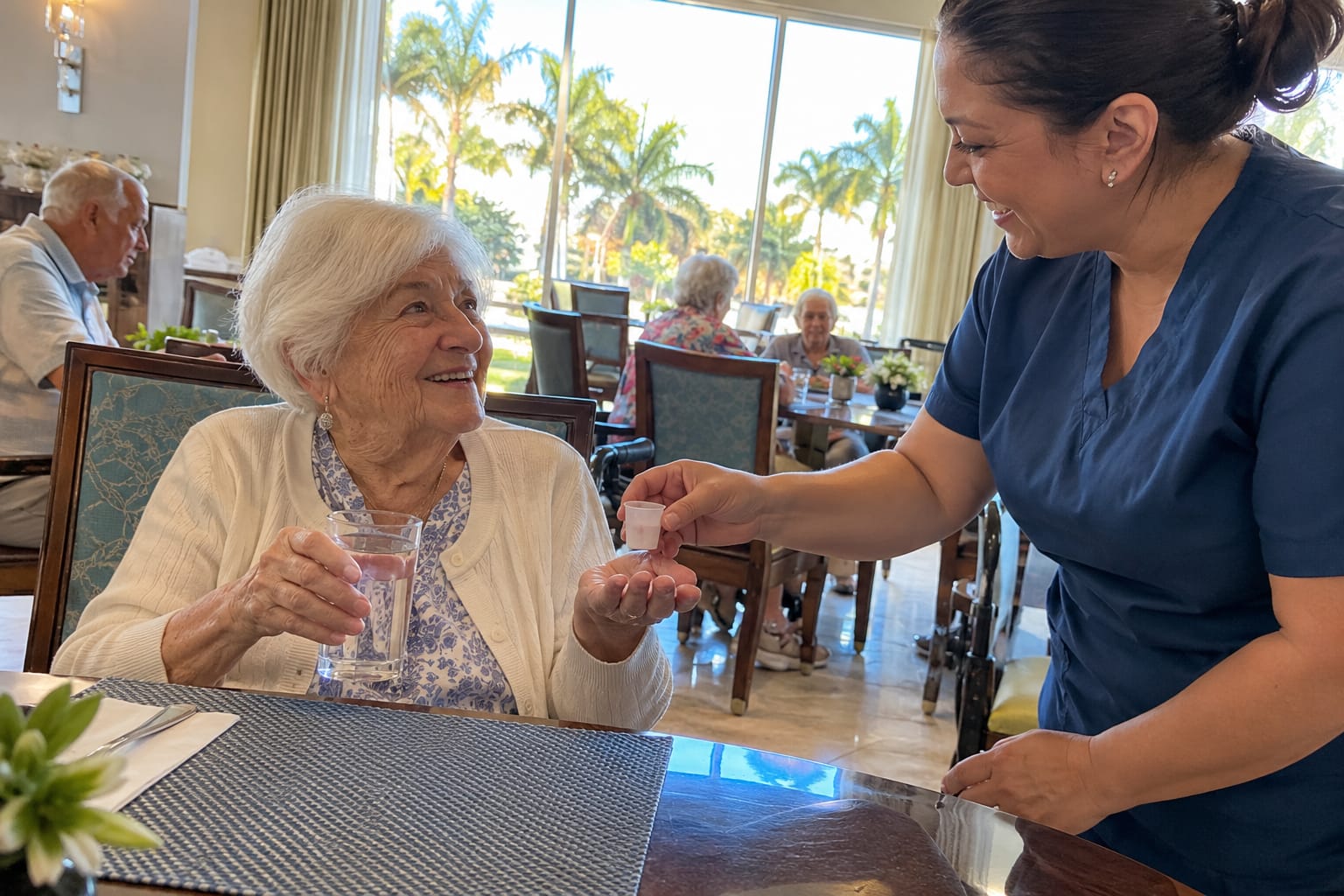
Two limits often surprise families. "Unlicensed staff may not provide assistance with the contents of pill organizers," so only a nurse can fill one. And except for those organizers, "no individual other than a pharmacist may transfer medications from one storage container to another" (rule 59A-36.008). An aide can't count out a weekend's pills into a baggie. Residents who manage their own medications may keep them "in their possession both on or off the facility premises."
The rule says nothing specific about controlled medications such as opioid pain relievers, or about residents whose medications a nurse gives. Ask the facility how it handles those, and ask a few days ahead so the pharmacy has time to prepare unit-dose packs if needed. Our guide to medication help in Florida assisted living explains who may do what.
What should you ask the facility before the trip?
- What's the sign-out procedure, and who do we call if we're running late?
- Which option will you use for medications, and when will they be ready?
- Can we have a current medication list with dose times?
- Does my parent need oxygen, a walker, incontinence supplies or a special diet while away?
- Who's the after-hours contact if something goes wrong?
- Does my parent's contract or Medicaid plan say anything about days away?
Do you still pay while your parent is away?
Almost certainly. A Florida contract must spell out "the rates or charges," and the refund policy applies "at the time of a resident's transfer, discharge, or death," not to a visit (s. 429.24, Florida Statutes). No Florida rule requires a lower rate for a holiday at home. Check your contract; our guide to contract clauses shows where to look.
Two programs have their own rules:
- Optional State Supplementation. Under the state's eligibility manual, "if an individual leaves the OSS facility for a period of 30 consecutive days, the individual is no longer eligible for OSS" (DCF policy manual). A holiday visit won't come close, but a long stay with family could.
- Medicaid long-term care. Bed-hold days for assisted living appear on AHCA's list of optional "expanded benefits" that some plans offer (AHCA). Ask your parent's plan what it covers.
What if your parent ends up in the hospital during the visit?
Original Medicare works anywhere: "You can use any doctor or hospital that takes Medicare, anywhere in the U.S." Medicare Advantage plans may require in-network providers for non-emergency care (Medicare.gov), so carry the plan card and know its emergency rules.
The facility doesn't have to hold the room. If it agrees to, the contract's bed-hold policy applies, and "until such notice is received, the agreed-upon daily rate may be charged" (s. 429.24; rule 59A-36.018). Call the facility as soon as your parent is admitted. Your parent keeps the right to 45 days' notice before any discharge, except in a physician-certified emergency (s. 429.28). A new medical exam is required after a "significant change," such as a stroke or major decline, but not after "short-term illnesses such as colds" (rule 59A-36.006; rule 59A-36.002). Our guide to returning after a hospital stay covers the rest.
How do you plan a holiday visit with a parent who has dementia?
The National Institute on Aging's advice is to "understand that things will be different, and be realistic about what you can do" (NIA). Its tips include:
- "Create a quiet space in case the person with Alzheimer's needs a break."
- "Limit the number of visitors at any one time."
- Avoid "crowds, changes in routine, and strange places."
- On a trip, "follow a routine like the one you use at home," and "be prepared to cut your visit short if necessary."
- Make sure your parent wears or carries ID, "such as an ID bracelet."
Keep "shoes, keys, suitcases, coats, hats, and other signs of departure out of sight," and don't leave someone with a history of wandering unattended (NIA). For some families, celebrating at the facility is the kinder choice. Our dementia care guide explains how Florida's new memory care license will work. Its rules aren't due until June 2027, so this season the current supervision rules apply.
Is your home ready?
The CDC says "more than one out of four older people falls each year," and "falling once doubles your chances of falling again" (CDC). Its home safety checklist (CDC STEADI) suggests you:
- remove loose rugs, or tape them down with non-slip backing;
- coil or tape cords along the wall;
- put a nightlight on the path to the bathroom;
- add a non-slip mat in the tub or shower.
Holiday decorations and visiting toddlers' toys add trip hazards. Our fall prevention guide has more.
What about flu, COVID and RSV?
Check your parent's vaccines before the gathering:
- Flu. Adults 65 and older should preferably get a high-dose, recombinant or adjuvanted vaccine (CDC).
- COVID-19. "A 2026-2027 COVID-19 vaccine is recommended for all adults ages 18 years and older," and adults 65 and older are recommended to get a second dose six months after the first (CDC).
- RSV. The CDC recommends "everyone ages 75 and older get an RSV vaccine," plus adults 50 to 74 at higher risk. It's not an annual shot (CDC).
Ask relatives who are sick to stay home, and remember your parent will bring back anything they catch to the people they live with.
What if you're flying?
Contact TSA Cares "at least 72-hours prior to your departure" at (855) 787-2227 for screening help. Wheelchairs come from the airline, not TSA (TSA). Travelers with dementia "can be screened without being separated from their traveling companion," and travelers 75 and older may keep their shoes on (TSA).
Federal rules require airlines to help passengers with disabilities from the terminal entrance to the gate and between connecting gates (14 CFR 382.91). They can't charge for it (14 CFR 382.31) or require advance notice, except for items such as medical oxygen (14 CFR 382.25). Request help when you book anyway.
What if it's easier to visit at the facility?
Residents can have visitors from at least 9 a.m. to 9 p.m., and "upon request, the facility shall make provisions to extend visiting hours for caregivers and out-of-town guests" (s. 429.28). Florida's No Patient Left Alone Act also applies to assisted living. Facilities can't require visitors to show proof of vaccination, must allow "consensual physical contact," and must let a resident's designated essential caregiver visit for at least two hours a day (s. 408.823, Florida Statutes). Ask whether you can reserve a private dining room. Our guide to how often to visit has ideas for making visits count.