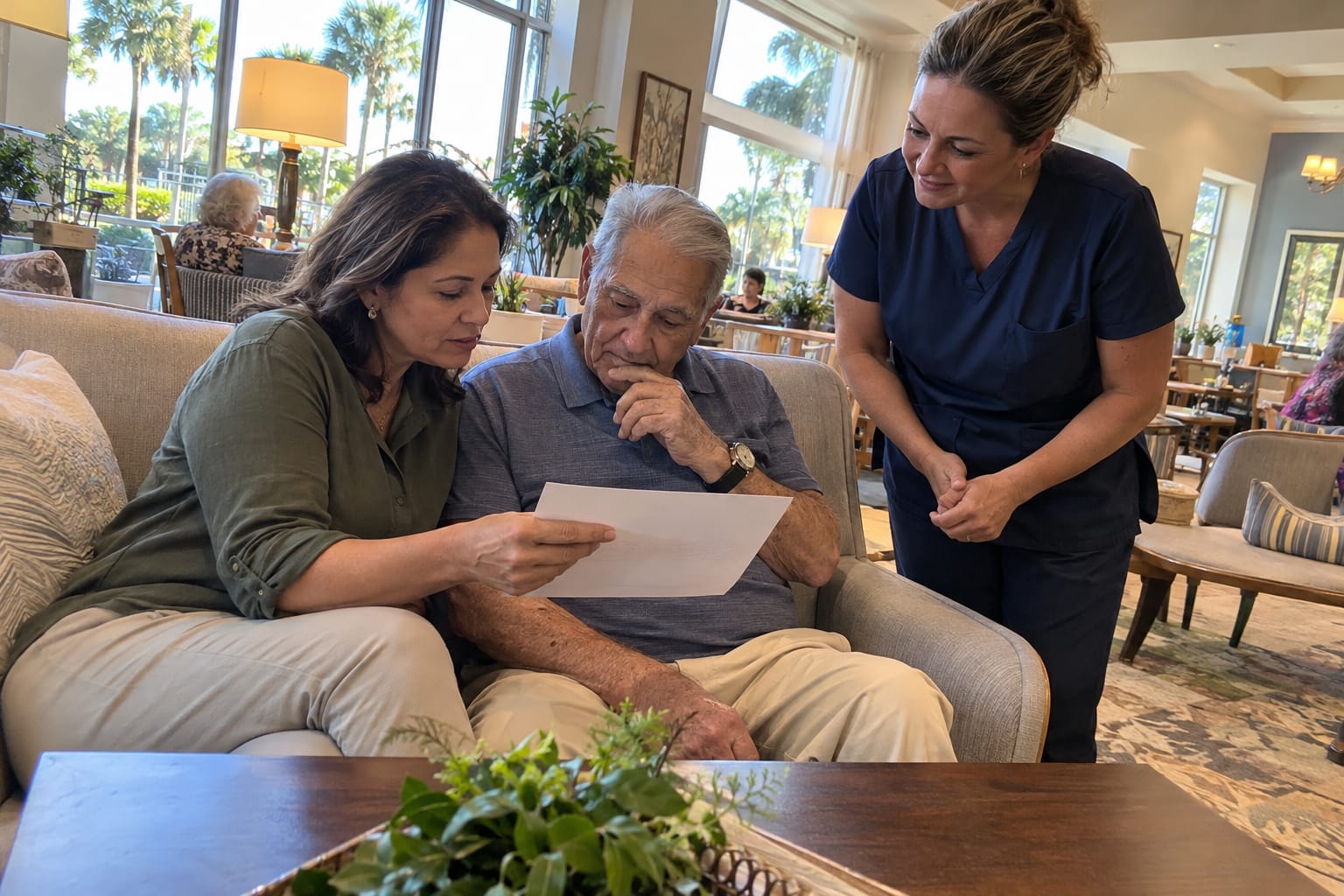
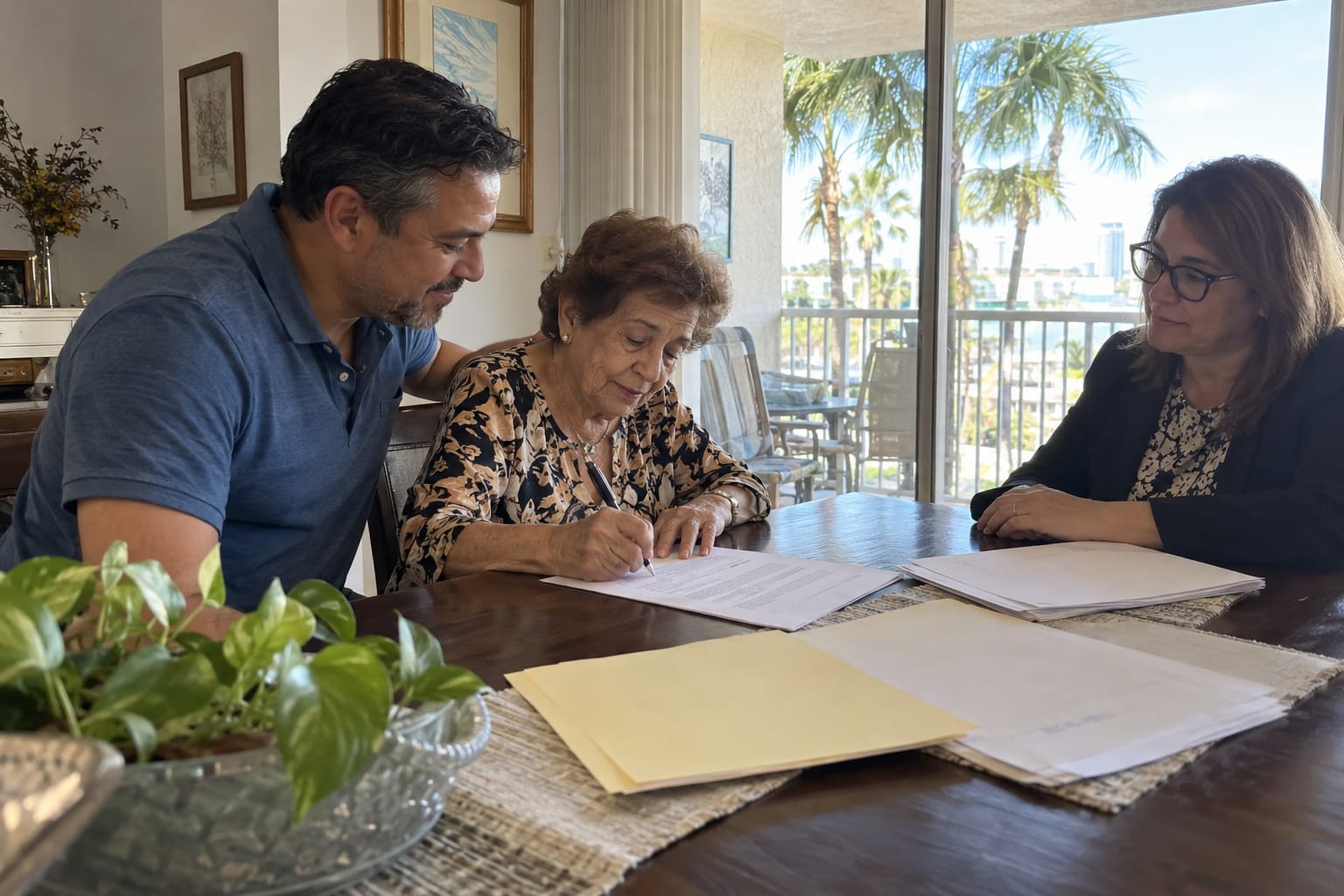
The short answer: Before a parent moves into assisted living in Florida, three documents do most of the work. A durable power of attorney lets someone handle their money and paperwork. A designation of health care surrogate lets someone make medical decisions, including admission to a facility. A Do Not Resuscitate Order (DNRO), on Florida's yellow DH Form 1896, applies only if your parent wants it. All of them have to be signed while your parent can still understand what they're signing. Without them, the fallback for money decisions is a court guardianship. This guide explains how each document works. It isn't legal advice, and free legal help is listed at the end.
Which documents does a parent need?
| Document | What it covers | How it's signed in Florida | Why the facility cares |
|---|---|---|---|
| Durable power of attorney | Money, bills, bank accounts, benefits paperwork | Parent, two witnesses and a notary (s. 709.2105) | Who signs the contract and pays the bill |
| Designation of health care surrogate | Medical decisions, including moving into or out of a facility | Parent and two adult witnesses, one of whom isn't a spouse or blood relative (s. 765.202) | Who staff call about care decisions |
| Living will | Wishes about life-prolonging treatment at the end of life | Parent and two witnesses (s. 765.302) | Shared with doctors and hospice |
| DNRO (DH Form 1896) | No CPR if the heart or breathing stops | Doctor (or PA or APRN) plus the parent or their surrogate, on yellow paper (s. 401.45) | Staff must follow it in an emergency |
How does a durable power of attorney work in Florida?
The agent can act from the day it's signed: a Florida power of attorney "is exercisable when executed." "Springing" powers that only start at incapacity are ineffective if signed after October 1, 2011 (s. 709.2108). To keep working once your parent loses capacity, it must say it's durable, with wording like "This durable power of attorney is not terminated by subsequent incapacity of the principal" (s. 709.2104).
Details that catch families out:
- General "do anything" wording grants nothing. Clauses that try "to give the agent authority to do all acts that the principal can do... do not grant any authority to the agent" (s. 709.2201). Each power has to be spelled out.
- Some powers need your parent's initials next to each one. These include making gifts, creating or changing a trust, and changing beneficiary designations (s. 709.2202). These matter if Medicaid planning is ever needed. Our Medicaid guide explains why.
- Banks have rules too. Four business days "are presumed to be a reasonable time" for a bank to accept or reject a power of attorney. A bank "may not require an additional or different form of power of attorney," and if it says no, it "must state in writing the reason for the rejection" (s. 709.2120).
- It can cover health decisions, but usually shouldn't be the only document. A durable power of attorney can include health care decisions if that authority is "specifically granted" (s. 709.2201). Most families still sign a separate surrogate form, because hospitals and facilities know it well.
The Florida Bar warns that "pre-printed forms may fail to provide the protection or authority desired" (Florida Bar consumer pamphlet), so this is the document most worth a lawyer's review.
What can a health care surrogate do?
A surrogate makes medical decisions when your parent can't. Your parent's doctor decides when that point has been reached, and while your parent still has capacity, "the principal's wishes are controlling" (s. 765.204). Since 2015, a parent can also let the surrogate act right away, without waiting for a finding of incapacity. On Florida's optional form, that's a box to initial, along with a separate box to let the surrogate receive health information (s. 765.203).
For assisted living, the key power is that a surrogate "may authorize the admission, discharge, or transfer of the principal to or from a health care facility or other facility or program licensed under chapter 400 or chapter 429." Chapter 429 is assisted living. The surrogate can also consent to a do-not-resuscitate order and "apply for public benefits, such as Medicare and Medicaid" (s. 765.205).
If there's no surrogate, Florida names a health care proxy in this order: a guardian, the spouse, a majority of the reasonably available adult children, a parent, a majority of adult siblings, a relative who has shown special care and concern, a close friend, and finally a clinical social worker chosen by a bioethics committee (s. 765.401). Several adult children who disagree can stall decisions, which is one good reason to name one surrogate and a backup.
How do DNR orders work in assisted living?
Florida only recognizes its own form. A DNRO "must be on the form adopted by rule of the department" (s. 401.45), which is DH Form 1896. The Department of Health says it "MUST be printed on yellow paper prior to being completed." It doesn't need a notary or witnesses, and "a properly completed DNRO does not expire" (Florida Department of Health). Your parent can cancel it at any time just by saying so (rule 64J-2.018).
In assisted living:
- The facility "must honor a properly executed DH Form 1896" (rule 59A-36.009).
- It "may not require execution of a DNRO as a condition of admission or treatment," and can lose its license for requiring one.
- At admission it must give your parent written information about advance directives under Florida law, and a copy of the DNRO form.
- If your parent has signed a DNRO, "a yellow copy of that document must be made a part of the resident's record." Keep the original somewhere you can find it fast.
Florida doesn't have a POLST law (a more detailed medical order form used in many states). Bills to create one died in 2024, 2025 and 2026 (Florida Senate, SB 312 (2026)). The yellow DNRO remains the form paramedics follow.
What will the facility ask for at admission?
Florida rules require the facility's admission package to include its "policy concerning Do Not Resuscitate Orders... and Advance Directives" (rule 59A-36.006). Resident records must include "documentation of the appointment of a health care surrogate, health care proxy, guardian, or the existence of a power of attorney" and the DNRO if there is one (rule 59A-36.015). Bring copies of everything on move-in day. Our contract clauses guide covers the residency agreement itself, which the agent or surrogate may be asked to sign.
What if my parent can no longer sign?
Your parent has to understand what they're signing. To the question "Must a person be competent to sign a power of attorney?" the Florida Bar's answer is simply "Yes" (Florida Bar). For medical decisions, the proxy order above still works. For money, the fallback is guardianship.
Florida courts treat guardianship as a last resort. It is "only warranted when no less restrictive alternative—such as durable power of attorney, trust, health care surrogate or proxy, or other form of pre-need directive—is found by the court to be appropriate and available" (Florida Courts). The process involves a petition, a court-appointed attorney for your parent, and a three-member examining committee appointed within 5 days, each reporting within 15 days. A hearing follows, and incapacity must be proven "by clear and convincing evidence" (s. 744.331). Committee and attorney fees are set by the court and paid from your parent's money. For people without the means or family to serve, Florida's Office of Public and Professional Guardians appoints local public guardians (Elder Affairs).
Where can we get free or low-cost help?
- Florida Senior Legal Helpline, 1-888-895-7873: free legal advice by phone for Floridians 60 and older who meet the income guidelines. Advance directives are one of the topics it covers (Elder Affairs).
- The Florida Bar Lawyer Referral Service, 800-342-8011: "a 30-minute consultation for no more than $25" (Florida Bar).
- Free state forms: AHCA's advance directives page has living will and surrogate forms, and says the procedures "are simple and do not require an attorney" (FloridaHealthFinder).
- The Elder Helpline, 1-800-963-5337: connects you to your local Aging and Disability Resource Center.
If your parent is in the hospital right now, our guide to going back to assisted living after a hospital stay covers the discharge paperwork. And if the conversation itself is the hard part, our scripts for talking to a parent may help.