
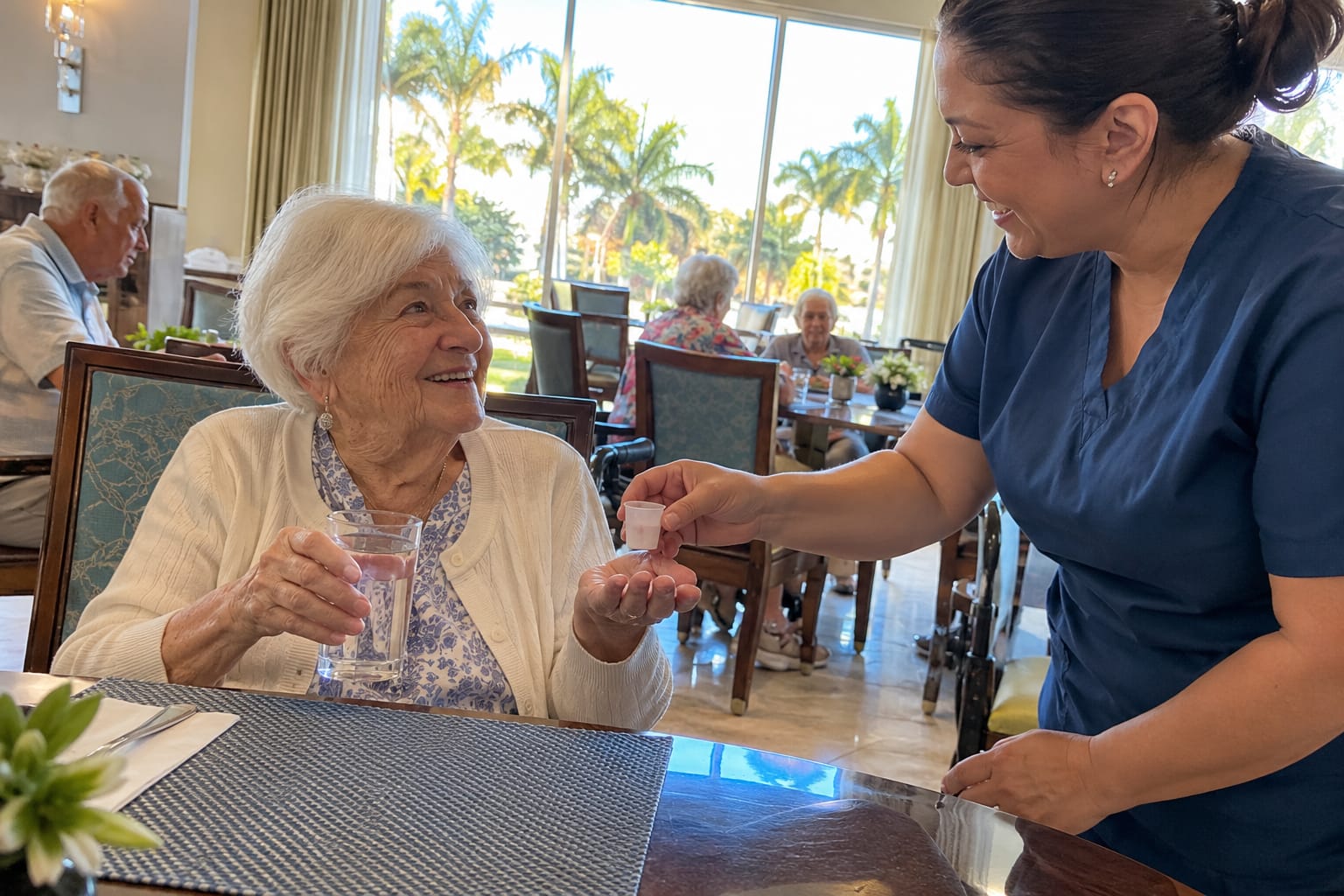
The short answer: In a Florida assisted living facility, medication help comes in three levels. Residents who can manage their own medicines are encouraged to keep doing so. Trained staff who aren't nurses can assist with self-administration: bringing the medicine, opening it, reading the label aloud and watching the resident take it. Only a licensed nurse can actually administer medication, and a facility doesn't have to employ one. Which level your parent needs, and whether the facility can provide it, should be settled before move-in.
What are the three levels of medication help?
Florida law draws clear lines between them:
- Self-administration. Residents who can manage their medications "shall be encouraged and allowed to do so" (s. 429.256). Residents may keep their medicines in their own room unless there's a safety reason not to.
- Assistance with self-administration. A trained, unlicensed staff member may help a resident "whose condition is medically stable" with "routine, regularly scheduled medications that are intended to be self-administered." The law says this help "shall not be considered administration."
- Administration. Licensed nurses "may administer medications to residents" (s. 429.255). This is the level for anything that needs a nurse's judgment.
Assistance requires a documented request and the written informed consent of the resident or their representative. Part of that consent is being told that "an assisted living facility is not required to have a licensed nurse on staff."
What can trained staff do when assisting?
Under s. 429.256, assistance covers oral medicines, topical medicines, transdermal patches, and eye, ear and nasal drops, sprays and inhalers. Trained staff may:
- bring the medicine to the resident in its original labeled container (including a pharmacist-prefilled insulin syringe or a manufacturer-prefilled insulin pen, which the resident then injects);
- confirm the medicine belongs to the resident, tell them its name and dose, open the container and remove the prescribed amount;
- place a pill in the resident's hand or lift the cup to their mouth;
- apply creams and other topical medicines;
- prepare a premeasured nebulizer dose;
- help with glucose meter checks, compression stockings, oxygen tubing and CPAP masks (but not adjusting the settings), and take vital signs.
The state's rule adds that staff may give verbal reminders and "must observe the resident take the medication" (rule 59A-36.008).
What can't they do?
Unlicensed staff may not (s. 429.256(4)):
- mix, compound, convert or calculate doses (measuring a prescribed liquid amount, or breaking or crushing a tablet as prescribed, is allowed);
- prepare syringes or give any injection;
- give tube feedings, IV preparations, irrigations, or rectal, urethral or vaginal medications;
- give "as needed" medicines unless the order has specific instructions that leave no room for judgment;
- give any medication that requires "judgment or discretion," which the rule defines as interpreting vital signs or assessing a resident's condition.
Staff also may not help with the contents of a pill organizer (rule 59A-36.008). If your parent uses a weekly pill box filled by family, ask how the facility will handle it.
How are the staff trained?
Before helping with medications, unlicensed staff must complete at least 6 additional hours of training from a registered nurse or licensed pharmacist, and then 2 hours of continuing education every year (s. 429.52). They must demonstrate the skills in person, and must be at least 18.
What if my parent needs medication administered by a nurse?
A facility can accept a resident who needs medication administered only if it employs a nurse, or if the resident arranges a licensed third party to do it (rule 59A-36.006). Nurses may not delegate administration to aides or unlicensed staff.
You don't need a specialty license for this. A standard-licensed facility "may also employ or contract with" licensed nurses "to administer medications" (s. 429.07). A Limited Nursing Services or Extended Congregate Care license goes further and allows other nursing care. Our guide to Florida assisted living license types explains the difference.
Common situations that need a nurse: insulin that has to be drawn up or dosed on a sliding scale, any other injection, and "as needed" medicine where someone has to judge whether it's needed.
How do "as needed" and over-the-counter medicines work?
As-needed (PRN) medicines can only be assisted by unlicensed staff if the order has specific limits, and the resident understands the purpose and can say when they need it. The rule's example of a usable order is "as needed for pain, not to exceed 4 tablets per day" (rule 59A-36.008). For vague orders like "as directed," the facility must contact the prescriber.
Over-the-counter products, including vitamins and supplements, don't need a doctor's order when a resident takes them alone or with help from unlicensed staff. An order is required if a nurse assists or administers.
How does the facility track it all?
For every resident who gets help or has medicines administered, the facility keeps a medication observation record, updated "each time the medication is offered or administered." It lists allergies, the prescriber, each drug's name, strength and directions, and any missed doses, refusals or errors.
Medicines kept centrally must be locked up. A resident "may not be compelled to take medications" but may be counseled. Ask to see how the record works, and who calls you if your parent refuses a dose.
How is this decided at admission?
Every resident has a health assessment within 60 days before or 30 days after moving in (s. 429.26), usually on AHCA Form 1823. The doctor checks whether your parent can self-administer, needs assistance, or needs medication administration, and the form notes that "not all assisted living facilities have licensed staff to perform this service."
Questions to ask on a tour
- Do you have a licensed nurse on staff or on call? How many hours a week?
- Who helps with medications on the night shift?
- Can my parent keep their own medicines in their room?
- How do you handle insulin, inhalers and as-needed pain medicine?
- Which pharmacy do you use, and can we keep ours?
- How will you tell us about missed doses or refusals?
AssistedLivingFacility.com lists 3,006 licensed Florida assisted living facilities across 54 counties as of October 2026. Shortlist by city in our Florida directory, then ask each one these questions. Our tour checklist has more.

