The short answer: Many Florida assisted living facilities can care for a resident with diabetes, including one who uses insulin, but there's a clear line between what aides and nurses may do. Trained aides can help with blood sugar checks and can hand your parent a pharmacy-prefilled insulin syringe or a factory-prefilled pen, but your parent must inject it. Aides can't give injections or work out a sliding-scale dose. If your parent can't inject, a nurse employed by the facility or a home health agency your family arranges can give the insulin. Facilities must serve diabetic diets as a doctor orders. Medicare caps insulin at $35 a month and covers meters, test strips and, for insulin users, continuous glucose monitors. About 18% of U.S. assisted living residents have diabetes, so ask each facility exactly how it handles it.
Can assisted living staff give insulin in Florida?
Not unless they're licensed nurses. Florida lets trained, unlicensed staff assist residents "with the self-administration" of routine medications, but that assistance "does not include... the preparation of syringes for injection or the administration of medications by any injectable route" (s. 429.256, Florida Statutes).
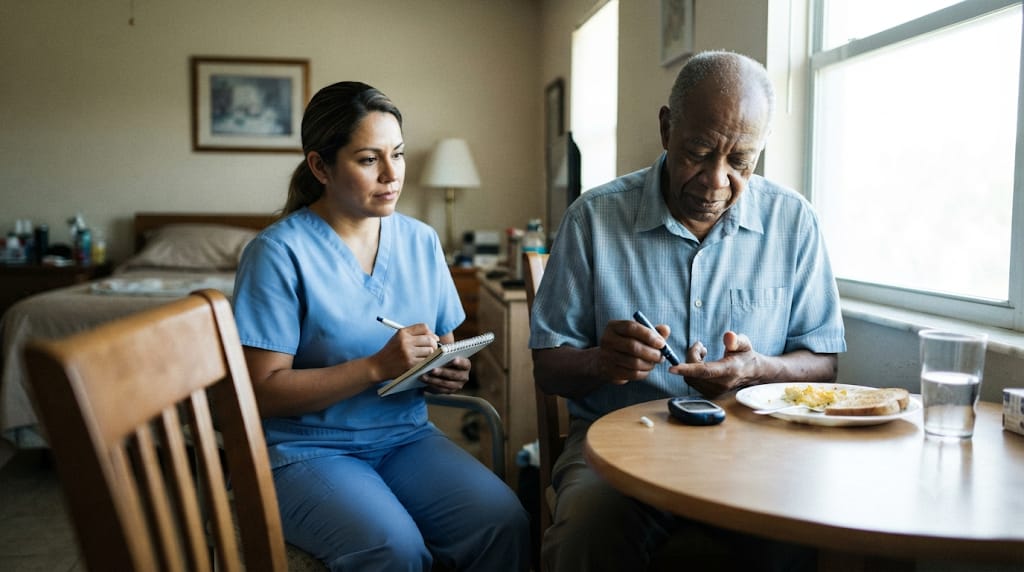
Aides can help with insulin in one specific way. The law treats "an insulin syringe that is prefilled with the proper dosage by a pharmacist and an insulin pen that is prefilled by the manufacturer" as medication in its labeled container. The training rule spells out the aide's role: taking the syringe or pen and "bringing it to the resident for self-injection" (rule 59A-36.011). Staff who assist with medications must complete at least six hours of training from a registered nurse or pharmacist, then two hours each year (s. 429.52).
| Task | Trained aide | Licensed nurse |
|---|---|---|
| Help with a fingerstick blood sugar check | Yes | Yes |
| Hand over a pharmacy-prefilled syringe or factory-prefilled pen for your parent to inject | Yes | Yes |
| Draw up insulin from a vial | No | Yes |
| Give an insulin injection | No | Yes |
| Decide a dose from a blood sugar reading (sliding scale) | No | Yes |
Aides also can't calculate doses or handle any medication whose amount or timing "requires judgment or discretion." Florida's rule defines judgment as "interpreting vital signs and evaluating or assessing a resident's condition" (rule 59A-36.008). Florida's rules don't use the words "sliding scale," but a dose that depends on a blood sugar reading falls on the judgment side of that line, so a nurse needs to handle it. Our guide to medication help in assisted living explains the rules for all medications.
What if your parent can't inject insulin?
They can still live in a standard assisted living facility. The admission rule says a facility "may accept a resident who requires the administration of medication if the facility employs a nurse who will provide this service" or the resident "contracts with a third party licensed to provide this service," such as a home health agency (rule 59A-36.006). If your family arranges a home health agency or private nurse, the facility "must allow for the receipt of those services" as long as your parent meets the admission criteria, and must coordinate with the provider (rule 59A-36.007).
Nurses can't train aides to take over. Facility nurses "may not delegate" nursing services to nursing assistants or unlicensed staff (rule 59A-36.006).
The limit is round-the-clock nursing. Outside of hospice, a facility "may not admit or retain a resident who is bedridden or who requires 24-hour nursing supervision" (s. 429.26). Diabetes complications can also cross the line: residents may not have stage 3 or 4 pressure sores, and facilities with only a standard or limited mental health license can't take residents who need dialysis performed in the facility (rule 59A-36.006). Our comparison of nursing homes and assisted living covers when a nursing home fits better.
Which license types offer more nursing?
Any licensed facility may employ or contract with nurses to give medications (s. 429.255). Two specialty licenses build nursing in:
- Limited nursing services (LNS) facilities must employ or contract with a nurse "available to provide such services as needed by residents" who don't require 24-hour nursing supervision (rule 59A-36.022).
- Extended congregate care (ECC) nurses "may provide any nursing service permitted within the scope of their license," and ECC facilities must offer dietary management, including special diets and monitoring what residents eat and drink (rule 59A-36.021).
Our guide to Florida license types explains each one, and our staffing guide covers who must be on duty day and night.
Can staff check blood sugar?
Yes. Florida lists "assisting with the use of a glucometer to perform blood-glucose level checks" among the tasks trained staff may help with (s. 429.256). If the facility runs blood sugar tests itself, it needs a federal laboratory certificate (CLIA). It doesn't need one when staff only help residents test with their own meters (rule 59A-36.008). Ask which way a facility does it.
Staff assisting with medications must watch your parent take them and report concerns to the doctor, and the facility keeps a daily record (rule 59A-36.008). Insulin kept in a shared refrigerator must be locked up.
Will the facility follow a diabetic diet?
It must. Facilities must provide "therapeutic diets as ordered by the resident's health care provider," and the menus must identify the foods that fit the diet. A licensed or registered dietitian or a licensed nutritionist reviews all menus every year. No more than 14 hours may pass between the end of the evening meal and the start of breakfast, which matters for overnight lows. If your parent refuses the diet, the facility documents it and tells the doctor (rule 59A-36.012). A person may not be admitted if they have "special dietary needs that cannot be met by the facility" (rule 59A-36.006).
What happens if blood sugar drops?
For many people with diabetes, a reading below 70 mg/dL is low. The risk is higher for people who take insulin, are 65 or older, or have cognitive impairment. The National Institutes of Health advises 15 to 20 grams of fast-acting carbohydrate and a recheck after 15 minutes, and glucagon for severe lows, followed by a call to 911 (NIDDK).
In a Florida facility, a staff member with current first aid and CPR cards must be in the building at all times, and facilities with 17 or more residents must have someone awake all night (rule 59A-36.011; rule 59A-36.010). The facility must contact the doctor and the family when a resident has a significant change (rule 59A-36.007). No rule names glucagon, and aides can help with "as needed" medications only when the order has specific parameters and the resident is aware of the need. Ask each facility who can give glucagon and whether there's an order on file. If your parent has memory loss, which raises the risk of lows, our dementia care guide is worth reading too.
What does Medicare cover for diabetes?
| What | Coverage |
|---|---|
| Insulin | No more than $35 for a one-month supply of each covered insulin, with no deductible. Pens and syringes fall under Part D; insulin used in a covered pump falls under Part B (Medicare.gov) |
| Meters, test strips, lancets | Part B, 20% coinsurance after the deductible (Medicare.gov) |
| Continuous glucose monitors | Part B, if your parent takes insulin or has a history of problem lows and is trained to use one (Medicare.gov) |
| Syringes, needles, swabs | Part D only; without it, your parent pays the full cost (Medicare.gov) |
| Diabetes self-management training | Up to 10 hours at first, then up to 2 hours a year (Medicare.gov) |
| Nutrition therapy with a dietitian | 3 hours the first year, 2 hours a year after, at no cost if your parent qualifies (Medicare.gov) |
| Eye and foot care | A yearly diabetic eye exam, and foot exams every 6 months for nerve damage (Medicare.gov; Medicare.gov) |
Medicare treats an assisted living facility as a home for medical equipment, so these supplies are covered there (CMS manual). Medicare's home health benefit may also pay a nurse to give daily insulin to a homebound resident who can't self-inject and has no one willing to do it. It won't pay for care the facility is already required to provide (CMS manual). In 2027, the Part B premium is $209.40 and the Part D out-of-pocket cap is $2,400. Medicare Open Enrollment ends December 7; our Open Enrollment guide explains how to check that a plan covers your parent's insulin and pharmacy.
How common is diabetes in assisted living?
Very. The CDC counts 28.8% of Americans 65 and older as having diabetes, diagnosed or not (CDC National Diabetes Statistics Report). In the 2025 federal survey of assisted living and similar communities, 17.9% of residents had diabetes (CDC National Post-acute and Long-term Care Study). Facilities see it every day, which is why the specifics matter more than a general "yes, we handle diabetes."
What should you ask a facility?
- Who will help with insulin, an aide or a nurse? Do you have a nurse on staff or under contract, and during which hours?
- If my parent can't inject, will your nurse give the insulin, or should we arrange home health?
- Does the pharmacy prefill syringes, or do you use factory-prefilled pens?
- Who decides the dose if the doctor orders sliding-scale insulin?
- Who does fingerstick checks, and with whose meter?
- Who is awake at 2 a.m., and what happens if my parent's sugar drops? Who can give glucagon?
- May I see the therapeutic menu and the dietitian's yearly review? When is the last snack?
- Where is insulin stored?
- What would make you decide my parent's diabetes care is more than you can provide?
- Is diabetes care or medication help an extra charge?
Bring our tour checklist for the rest of the visit, and see our levels of care guide for how care needs affect the monthly price. If your parent is coming out of the hospital on a new insulin plan, our guide to assisted living after a hospital stay explains the handoff.