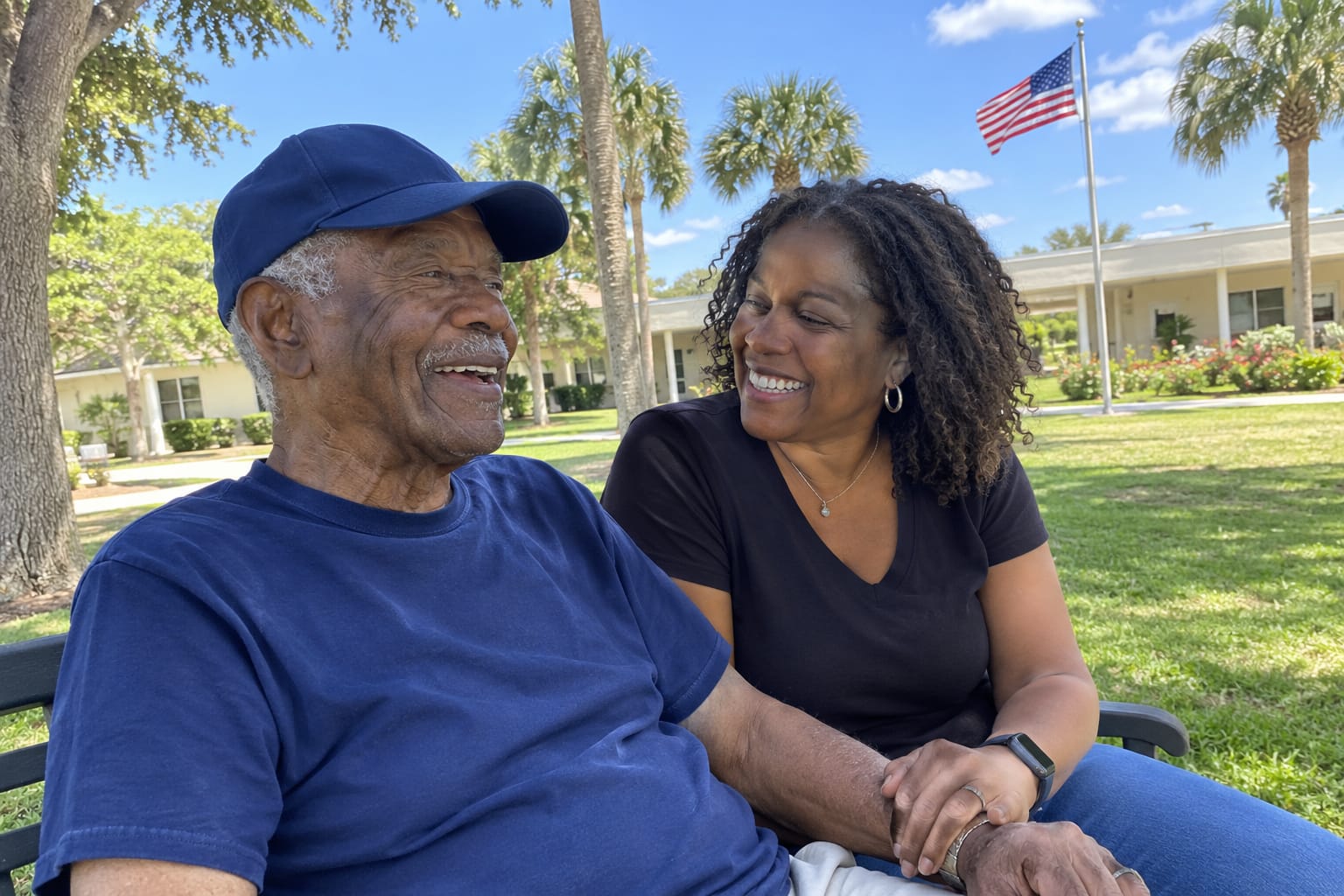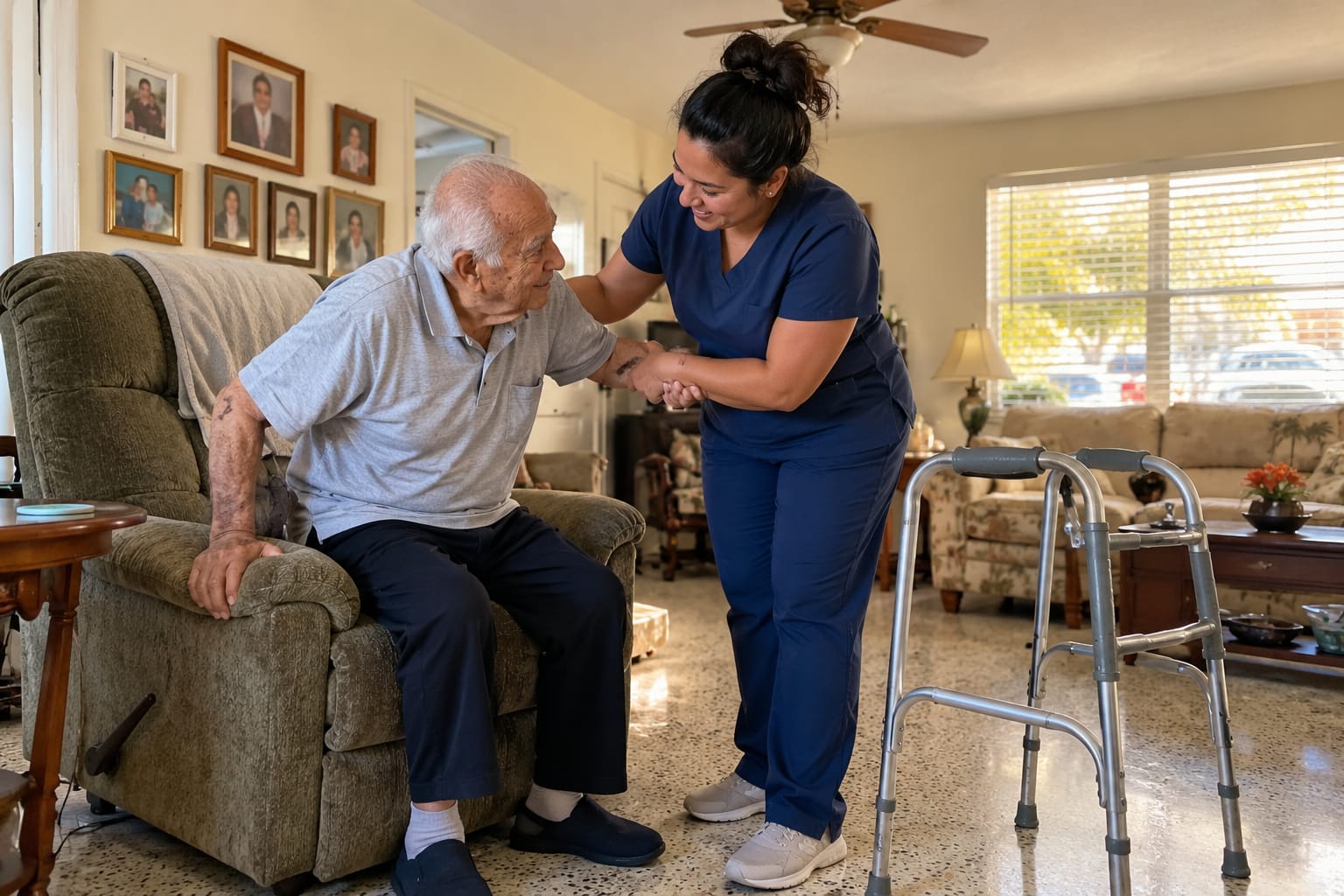
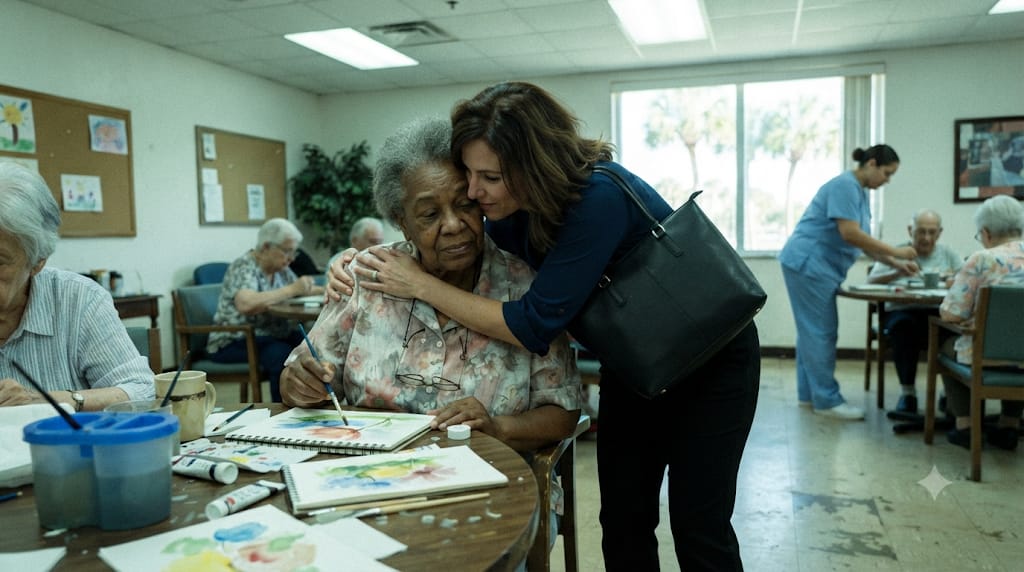
The short answer: Adult day care is a daytime program. Your parent keeps living at home, often with you, and spends part of the day at a licensed center with meals, activities, supervision and other people. Assisted living is a home, with staff around the clock. Adult day care works when someone can cover evenings, nights and weekends, and when your parent can take their own medicines or the center has a nurse. When nights become unsafe or the caregiver is worn out, assisted living usually fits better. Florida licenses about 466 adult day care centers, more than half of them in Miami-Dade, compared with roughly 3,000 assisted living facilities. Medicaid long-term care, the VA and state programs can help pay for both.
What is an adult day care center in Florida?
Florida law defines an adult day care center as a place that provides, "for a part of a day, basic services to three or more persons who are 18 years of age or older" and who aren't related to the owner. Basic services include "a protective setting that is as noninstitutional as possible," social and health activities, rest, meals and respite care for the family (s. 429.901, Florida Statutes). AHCA, the state's Agency for Health Care Administration, licenses each center (s. 429.907).
The state rules set the basics you'd see on a visit (ch. 59A-16, Florida Administrative Code):
- Centers are open at least five hours a day on weekdays and may offer reduced weekend hours.
- Anyone at the center for four or more hours gets a meal covering at least a third of the day's nutrition needs, plus snacks.
- Activities must be available at least 60% of the time the center is open, with a monthly calendar posted.
- If the center provides or arranges transportation, no ride can last more than two hours.
There's no minimum age beyond 18. Nationally, 30.7% of adult day participants were under 65 in 2025, and 64.5% had some care paid by Medicaid (CDC National Post-acute and Long-term Care Study).
How do adult day care and assisted living compare?
| Adult day care center | Assisted living facility | |
|---|---|---|
| Where your parent sleeps | At home | At the facility |
| Hours | Part of the day, at least 5 hours on weekdays | 24 hours a day |
| Minimum staffing | 1 staff member for every 6 participants, never fewer than 2 | Weekly staff hours set by resident count, with awake overnight staff at 17 or more residents |
| Nurse on site | Not required in a standard center | Not required for a standard license |
| Medication | Only licensed staff, such as nurses, may give it; other staff can remind and supervise | Trained staff may help residents take their own medicines |
| Medicaid long-term care | Covers adult day care | Covers care services, not room and board |
| How many in Florida | About 466 centers (May 2026) | 2,989 licensed (January 2026) |
Sources: rule 59A-16.102; rule 59A-16.109; rule 59A-36.010; s. 409.98; FloridaHealthFinder; Senate bill analysis. The center count is our tally of AHCA's FloridaHealthFinder list.
Location matters. By our count of that list, about 57% of Florida's adult day centers have Miami-Dade ZIP codes, while many mid-size counties have only a handful. Our Florida directory lists 3,006 licensed assisted living facilities across the state, so in much of Florida there are far more assisted living options than day centers.
What are the staffing and medication rules?
A standard center must have "one Staff member who provides direct services for every six Participants" present at all times, and never fewer than two staff, one of them certified in first aid and CPR. The owner or a designated responsible person must be on the premises whenever the center is open (rule 59A-16.102). Every employee completes dementia training: one hour within 30 days of hire, and three more hours within seven months for staff who provide personal care (s. 430.5025).
A standard center doesn't have to employ a nurse. Centers that offer the higher "adult day health care" level must have a registered or licensed practical nurse on site during their main hours (rule 59A-16.106).
Medication is where adult day care differs most from assisted living. Participants who can manage their own medicines may bring them, and staff can remind them and supervise. But "in no instance shall medication be administered by a person other than one licensed" to do so, such as a nurse (rule 59A-16.109). A center may not admit or keep a participant who needs medication given during the day unless it has licensed staff to do it (rule 59A-16.102). Our guide to medication help in assisted living explains the assisted living rules.
What about adult day care for dementia?
Florida has a special designation for centers that serve people with Alzheimer's disease and related dementias. A center may not claim to provide specialized Alzheimer's services unless AHCA has designated its license (s. 429.917). A designated center must (s. 429.918):
- keep at least one direct-care staff member for every five participants with dementia;
- have a registered or licensed practical nurse on site at least 75% of the time it's open;
- offer therapeutic activities at least 70% of the time;
- provide hands-on help with daily activities, including incontinence care;
- be a secured unit, or have alarms on every door participants can reach.
Participants need a documented dementia diagnosis, must need ongoing supervision, and must not be actively showing aggressive behavior that puts themselves or others at risk of harm. A center without the designation can still serve people with dementia, so ask what training and staffing it has. In the latest state-level federal data, from 2020, 46.8% of Florida adult day participants had Alzheimer's or another dementia, compared with 24.7% nationally (CDC). Our dementia care guide covers what assisted living facilities must provide.
What does adult day care cost, and who pays?
No government source publishes an average private-pay price for adult day care in Florida. The closest official figure is what the VA pays community centers: in 2026, $121.33 for a full day in Miami, $121.73 in Fort Lauderdale and $118.75 in the rest of Florida (VA fee schedule). That's a payment ceiling, not a price list. At those rates, three full days a week would come to roughly $1,550 a month, by our estimate. Ask each center for its daily and half-day rates in writing. If a center accepts private-pay participants, it must have a signed agreement showing the fee, the days and hours, and the services (rule 59A-16.107).
Who else pays:
- Medicaid long-term care must cover adult day care (s. 409.98). Eligibility is the same as for assisted living: age 65 or older (or 18 or older with a disability), a CARES assessment showing a nursing-home level of care, and a place through the pre-enrollment list (s. 409.979). Our Medicaid guide explains the program.
- Medicare doesn't pay for adult day care, which it treats as long-term care (Medicare.gov).
- The VA offers adult day health care in its standard medical benefits package for enrolled veterans who meet the clinical criteria (VA). There's no copay for the first 21 days of extended care in a 12-month period, then up to $15 a day (38 CFR 17.111).
- State programs run through Florida's 11 area agencies on aging. The Alzheimer's Disease Initiative funds respite, including adult day care, for caregivers of adults 18 and older with dementia, and Community Care for the Elderly lists adult day care among its services for people 60 and older (Elder Affairs; Elder Affairs). Neither charges a co-payment to clients at or below the federal poverty level (Elder Affairs). Call the Elder Helpline at 1-800-963-5337.
There's a federal tax break too. If your parent lives with you, can't care for themselves and attends adult day care so you can work, the cost can count toward the Child and Dependent Care Credit. Care outside your home counts only if your parent "regularly spends at least 8 hours each day in your home" (IRS Publication 503). For 2026, the IRS's draft instructions raise the credit to between 50% and 20% of up to $3,000 in expenses for one person (IRS draft Form 2441 instructions). You can't use the same dollars for both this credit and the medical expense deduction. Our guide to whether assisted living is tax deductible covers the medical side.
How can adult day care and assisted living work together?
Florida lets assisted living facilities, hospitals and nursing homes provide daytime services to adults who don't live there without a separate adult day care license. If one "holds itself out to the public as an adult day care center," it must be licensed as one (s. 429.905). Those day participants need space beyond what the facility's own residents require (rule 59A-16.109), and assisted living staffing minimums count day participants and respite residents along with full-time residents (rule 59A-36.010).
That opens a gradual path. A parent might attend a day program at an assisted living facility, then try a short respite stay there, before deciding on a move. Florida Medicaid lists assisted living facilities as providers of both adult day care and respite (AHCA coverage policy). Our respite care guide explains how short stays work. It also works in reverse: assisted living residents who attend outside day programs can count those hours toward the 12 hours a week of activities their facility must schedule (rule 59A-36.007).
When is adult day care no longer enough?
The rules themselves point to the signs:
- Medicines need to be given, not just reminded, and the center has no nurse (rule 59A-16.102).
- Your parent needs more care than the center is licensed to provide. A center doesn't have to keep a participant "whose behavior and physical limitations are deemed hazardous," though it must allow 15 days to arrange other care except in emergencies (rule 59A-16.103).
- The hard hours are at night. Wandering, falls or confusion after dark fall to the family, because a center covers only part of the day.
- The caregiver is exhausted. Adult day care gives a family caregiver a break during the day. If the evenings and weekends are no longer manageable, that's a sign too.
Our guide to the signs it may be time for assisted living goes further, and our comparison of in-home care and assisted living covers the other way to stay home longer. If cost is the worry, see what happens if your parent runs out of money. Small homes are another middle option: see our comparison of adult family-care homes and assisted living.
How do you check a center?
AHCA's FloridaHealthFinder lists every licensed adult day care center, with inspection reports and legal actions on each profile. Licenses last two years, and inspections are unannounced (s. 408.808; s. 408.811). On a visit, check:
- The license is posted, and any claim of specialized Alzheimer's care matches a designated license.
- You get a written statement of services, charges and the refund policy.
- The staff count meets 1 to 6, or 1 to 5 in a designated dementia center.
- You know whether a nurse is on site, and when.
- The activity calendar is posted and the room is busy, not just a television.
- The center has an emergency plan and registers participants who need evacuation help with the county special needs registry (rule 59A-16.104).
Complaints about a licensed center go to AHCA at 1-888-419-3456 (AHCA). Report suspected abuse to the Florida Abuse Hotline at 1-800-962-2873.