The short answer: In-home care is usually cheaper when a parent needs a few hours of help a day. Assisted living is usually cheaper once they need someone nearby around the clock. The crossover comes at roughly 8 to 12 hours of paid help a day. In Florida, the median home care aide earns $16.25 an hour, so 24-hour care costs close to $12,000 a month in wages alone, before an agency adds its share. Cost isn't the only test, though. Safety at night, falls and the strain on a family caregiver often decide it first.
What does in-home care cost in Florida?
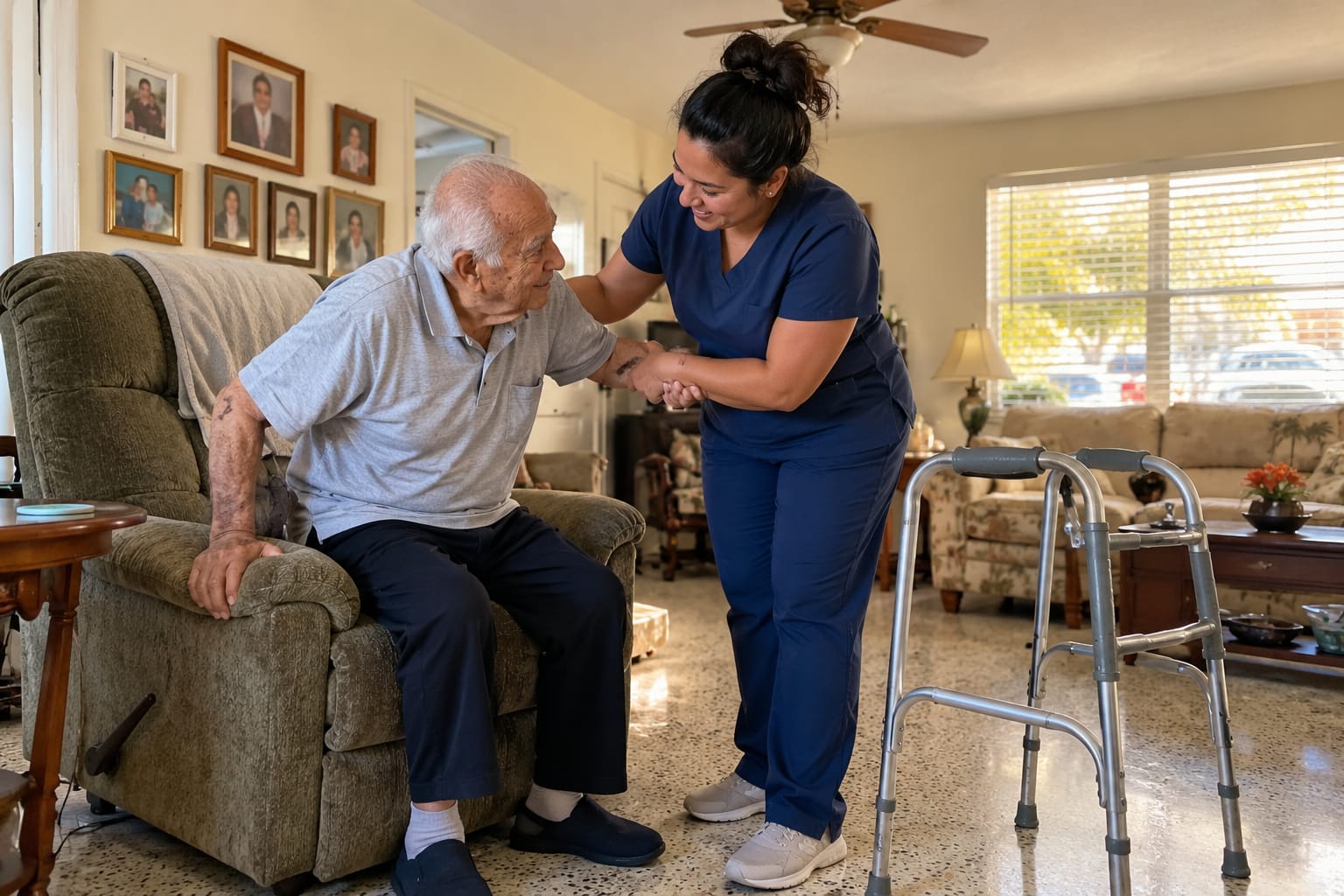
There is no official Florida survey of home care agency rates. What the government does publish is what aides earn. The U.S. Bureau of Labor Statistics' May 2025 figures put the median wage for home health and personal care aides in Florida at $16.25 an hour (BLS occupational wages, Florida). Florida's minimum wage rose to $15.00 an hour on September 30, 2026 (FloridaCommerce), which sets a floor under that pay.
An agency charges more than the aide earns, because its rate also covers payroll taxes, insurance, supervision and scheduling. So treat the numbers below as the minimum, not a quote:
| Hours of help a day | Hours a month | Aide wages alone at $16.25/hour |
|---|---|---|
| 4 | 122 | about $1,980 |
| 8 | 243 | about $3,950 |
| 12 | 365 | about $5,930 |
| 24 (around the clock) | 730 | about $11,860 |
Pay varies a little by region. The median is $16.90 in the Naples area, $16.45 in Tampa, $16.40 in Orlando, $16.53 in Jacksonville and $15.81 in the Miami–Fort Lauderdale–West Palm Beach area (BLS).
What does assisted living cost by comparison?
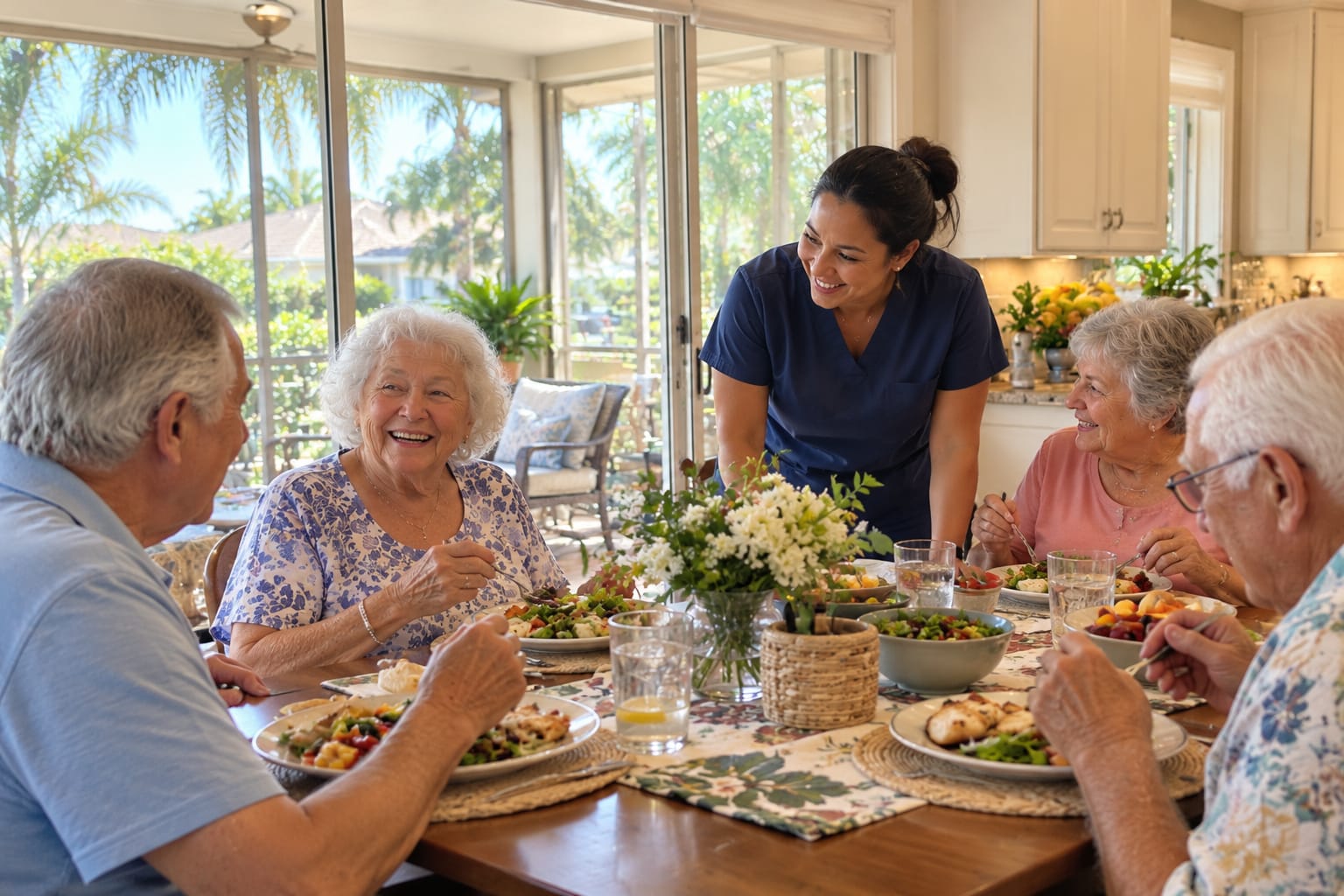
Assisted living bundles room, meals, supervision around the clock and help with daily activities into one monthly bill. Public operators report averages in their filings. Brookdale Senior Living, the largest U.S. operator, averaged $7,042 a month per occupied assisted living and memory care unit in the second quarter of 2026 (SEC filing). Sonida Senior Living averaged $4,969 for assisted living in 2025 (SEC filing). Those are national company averages, not Florida prices, but they show the range. Our Florida cost breakdown explains what drives a local bill.
The National Institute on Aging puts the trade-off plainly: "Home-based services can be expensive, but they may cost less than moving into a residential facility" (NIA). Remember too that staying home still means paying for the house, utilities, food and repairs. Assisted living covers most of that in one bill.
Which costs less for our family?
A rough guide, based on the wage figures above:
- A few hours a day (bathing, meals, errands): home care almost always costs less.
- 8 to 12 hours a day: the costs start to overlap. The house, groceries and night-time coverage tip the balance.
- Someone nearby 24 hours a day: assisted living usually costs much less, because staff are shared across residents. In Florida, a facility with 17 or more residents must have "at least one staff member awake at all hours" (rule 59A-36.010).
Dementia often decides it. Florida's Department of Elder Affairs notes that "as Alzheimer's disease progresses, especially in its later stage – individuals will require care 24 hours a day" (2025 Year in Review).
What kinds of home care are licensed in Florida?
The type of provider determines what they're allowed to do, so it matters:
- Home health agencies must be licensed (s. 400.464) and can provide personal care, which Florida law defines as help "in the activities of daily living, such as dressing, bathing, eating, or personal hygiene" (s. 400.462).
- Companion and homemaker services only need to register with the state, and the law is blunt: "A companion may not provide hands-on personal care to a client" (s. 400.462; s. 400.509). The same rule applies to homemakers.
- Nurse registries place caregivers who are "deemed an independent contractor and not an employee of the nurse registry," and the registry must tell you it "may not monitor, supervise, manage, or train a caregiver" (s. 400.506).
- A private hire working alone is exempt from licensing (s. 400.464(6)(e)). The state's consumer guide warns that if you hire someone directly, "you may be required to pay" household employment taxes (FloridaHealthFinder).
Licensed agencies, registries and companion services must run level 2 background screening on their workers (s. 400.512). You can look up any licensed provider and its inspection reports on FloridaHealthFinder.
What do Medicare and Medicaid pay for?
Medicare covers home health only for people who are homebound and need part-time or intermittent skilled care. That usually means "up to 8 hours a day (combined), for a maximum of 28 hours a week." Medicare doesn't pay for "24-hour-a-day care at your home," or for "custodial or personal care" when that is the only care you need (Medicare.gov). It doesn't pay for assisted living either. Our Medicare guide covers what it does pay for.
Florida Medicaid's long-term care program can pay for either setting. By law its plans cover services in assisted living facilities, adult day care, personal care, home-delivered meals and respite (s. 409.98). In 2026 the income limit is $2,982 a month and the asset limit is $2,000 (DCF). As of April 2026, 116,521 of the program's 166,181 enrollees were getting home and community-based care rather than nursing home care (House bill analysis, HB 915). Enrollment isn't immediate: Florida now keeps a statewide "pre-enrollment list" (s. 409.979), explained in our waitlist guide.
State programs run by Elder Affairs help some families keep a parent at home:
- Community Care for the Elderly is for people 60 and older who are "functionally impaired," and charges a sliding-scale co-pay (Elder Affairs).
- Home Care for the Elderly pays "a basic subsidy of $160 per month" when an approved adult caregiver lives with the older person (Elder Affairs).
- The Alzheimer's Disease Initiative funds in-home and facility respite (Elder Affairs).
These programs have pre-enrollment lists too. Call the Elder Helpline at 1-800-963-5337 to get screened.
Veterans can use VA pension with Aid and Attendance for either setting: "You can use your Aid and Attendance payments to help pay for the services that you need" (VA). For a single veteran, the maximum is $29,093 a year (VA rates). VA also offers a Homemaker and Home Health Aide program through contracted agencies. See our Aid and Attendance guide.
When has home care stopped working?
The NIA suggests families ask practical questions, like whether a parent "can prepare meals on a stove safely" and whether they have the medications they need. It lists confusion, falls and trouble walking as warning signs (NIA). Falls are common: "more than one out of four older people falls each year, but less than half tell their doctor" (CDC).
Signs it may be time to compare assisted living:
- Night-time needs, such as wandering, toileting help or repeated falls, that daytime shifts don't cover.
- Paid hours creeping past 8 to 10 a day.
- Missed or mixed-up medications. Our guide to medication help in assisted living explains who can help there.
- A family caregiver who is worn out. NIA warns that caregivers face "a higher risk of physical and mental health issues" (NIA).
- Isolation: long days alone between visits.
Our article on the signs it's time to consider assisted living goes deeper.
Can you combine the two?
Yes. Florida rules let assisted living residents bring in outside help. Nothing in the licensing rules prohibits a resident "from independently arranging, contracting, and paying for services provided by a third party of the resident's choice, including a licensed home health agency or private nurse" (rule 59A-36.007). Families also use short respite stays to try assisted living before committing, or choose a small home. Of the 3,006 licensed Florida facilities in our directory, 1,446 have six or fewer beds, a homelike middle ground between a house and a large community. Adult family-care homes are another option.
Assisted living also brings oversight that a private arrangement doesn't. Florida inspects facilities without warning ("all inspections shall be unannounced") at least every two years for relicensure (s. 408.811). Browse licensed options near your parent in our Florida directory.