
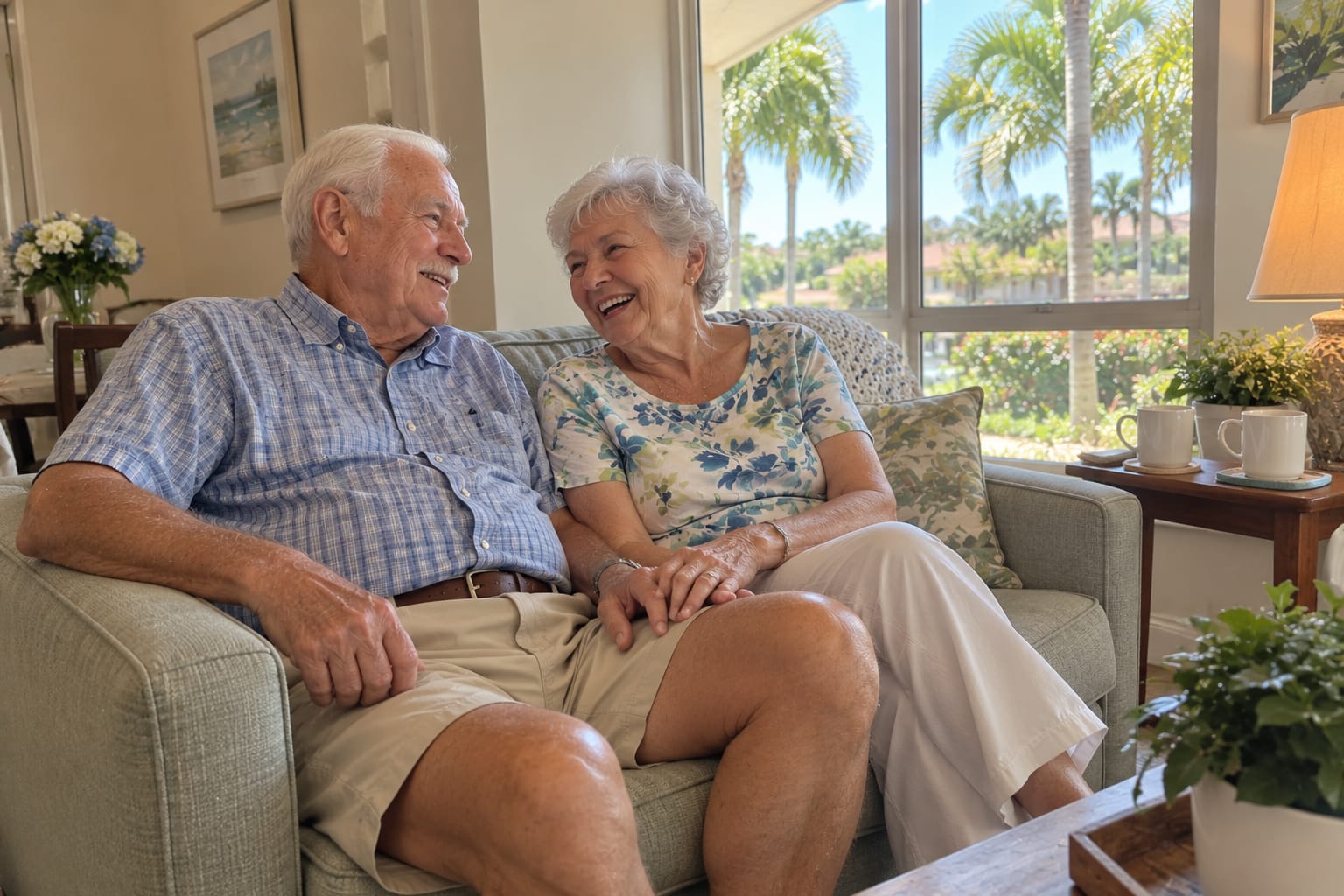
The short answer: Yes, married couples can live together in Florida assisted living, and the law protects it: every resident has the right to "share a room with his or her spouse if both are residents of the facility" (s. 429.28). The harder questions are what happens when one spouse needs much more care than the other, and how to pay without leaving the healthier spouse short. Medicaid has specific protections for the spouse who keeps living at home, and in 2026 they are worth more than many families expect.
Can a married couple share an apartment in assisted living?
Yes. Florida's resident bill of rights gives spouses the right to share a room when both live in the facility (s. 429.28(1)(g)). The state's long-term care ombudsman lists the same right on its residents' rights page.
How much space you get depends on the building. Florida's licensing rule points to the Florida Building Code (rule 59A-36.014), which sets minimums for assisted living bedrooms:
| Room type | Minimum usable floor space |
|---|---|
| Single bedroom | 80 square feet, not counting closets or bathrooms |
| Shared bedroom | 60 square feet per person (120 square feet for a couple) |
| Maximum per bedroom | Two people, in facilities licensed or renovated since about 2000 |
Older buildings follow the code in force when they were first licensed, so room sizes vary. Those are the legal minimums. Most couples look for a one-bedroom or two-room apartment so each spouse has some space of their own.
The type of building matters too. Of the 3,006 licensed Florida facilities in our directory, 1,446 are small homes with six or fewer beds. These homes usually have shared or single bedrooms rather than apartments. Larger communities are more likely to offer couples' suites. Our comparison of large and small facilities covers the trade-offs.
How do facilities charge for a second person?
Most charge a base rate for the apartment, plus a "second person fee" for the spouse, and then a separate care fee for each spouse based on their own needs. We found no official Florida survey of second-person fees, so ask each facility for theirs in writing.
Florida law helps you compare. The contract must state "the services and accommodations to be provided by the facility; the rates or charges" and give 30 days' written notice of any increase (s. 429.24). The admission package must state the daily, weekly or monthly charge to live there (rule 59A-36.006). Ask for a quote for both spouses at their current care levels. Then ask what the bill would be if one of them moved up a level, because that usually happens to one spouse first. Our guide to assisted living rate increases covers how to budget for it.
What happens when spouses need different levels of care?
This is the moment many couples dread. Florida assisted living has limits: a facility "may not admit or retain a resident who is bedridden or who requires 24-hour nursing supervision" (s. 429.26). A resident may be bedridden for up to 7 consecutive days in a standard facility, and up to 14 in a facility with an Extended Congregate Care (ECC) license (rule 59A-36.021).
Some ways couples stay together longer:
- Choose a facility with an ECC license. ECC facilities are meant to "promote aging in place" (s. 429.26), so the spouse with more needs can stay longer. Only 171 of Florida's roughly 2,989 facilities held an ECC license in January 2026. Our guide to Florida license types explains each one.
- Hospice is an exception. A resident who would otherwise have to leave can stay if the facility and resident agree and a licensed hospice provides the extra care (s. 429.26). Read more in our hospice in assisted living guide.
- Dementia care is changing. A 2026 law created a memory care services license. It will be required for any facility that serves memory care residents or advertises memory care, and rules are due by June 1, 2027 (s. 429.076). Ask whether a spouse with dementia could stay in your shared apartment or would need to move to a secured unit, and how often the couple could be together.
If one spouse must move to a nursing home, Florida assisted living residents still have protections. A facility must give "at least 45 days' notice of relocation or termination of residency" (s. 429.28). In a nursing home, federal rules for Medicare- and Medicaid-certified homes give married residents "the right to share a room with his or her spouse" when both live there and both agree (42 CFR 483.10). Florida also lets each resident name an "essential caregiver," and a facility "must allow in-person visitation by the essential caregiver for at least 2 hours daily" (s. 408.823). A spouse can be that person. Our nursing home vs. assisted living guide explains the differences in care.
How does Medicaid protect the spouse who stays home?
Florida's Medicaid long-term care program can pay for care in assisted living as well as nursing homes. When only one spouse needs care, federal "spousal impoverishment" rules stop the other spouse from having to spend down to almost nothing. Florida's eligibility manual says the resource allowance policy applies to the SMMC long-term care program, which covers assisted living, not only to nursing homes (DCF policy manual 1640.0205).
Florida's July 2026 figures (DCF Appendix A-9; CMS 2026 standards):
| Standard | 2026 amount |
|---|---|
| Assets the spouse at home can keep (community spouse resource allowance) | $162,660, the federal maximum |
| Minimum monthly income for the spouse at home | $2,705 (from July 1, 2026) |
| Maximum monthly income allowance for the spouse at home | $4,067 |
| Home equity limit | $752,000 |
| Income limit for the spouse applying | $2,982 a month |
| Asset limit for the spouse applying | $2,000 |
If the spouse who stays home has income below the minimum, part of the applying spouse's income can go to them. If the applying spouse's income is over $2,982, Florida requires a qualified income trust, which "cannot be funded retroactively" (DCF Appendix A-22.1). Set it up before the month you need coverage.
Two cautions. First, Medicaid long-term care isn't immediate: Florida keeps a pre-enrollment list, explained in our waitlist guide. Second, not every assisted living facility accepts Medicaid. Our guide to whether Medicaid pays for assisted living covers how to find one that does.
What if both spouses need care?
If both spouses apply for Medicaid long-term care, the asset limit is "$2,000 for an individual ($3,000 for eligible couple)" (DCF policy manual 1640.0205). Spouses who live together "can choose whether to be considered as a couple or as individuals, whichever is to their advantage" (DCF policy manual 2240.0613). The protected allowance for a spouse at home doesn't apply when neither spouse lives at home, so this choice is worth discussing with an elder law attorney.
Lower-income couples may qualify for Florida's Optional State Supplementation. In January 2026 the couple income standard was $2,047.80 a month, the couple provider rate was $1,939.80, and each spouse kept a $160 personal needs allowance (DCF standards).
Are there VA benefits for married veterans?
Yes. VA pension with Aid and Attendance pays more when there is a spouse. For December 2025 through November 2026, the maximum annual rate is $34,488 for a veteran with one dependent spouse. When two veterans are married to each other and both qualify for Aid and Attendance, it is $46,143 (VA pension rates). The net worth limit is $163,699. Our Aid and Attendance guide explains how to apply.
What should couples ask on a tour?
- Do you have one-bedroom or two-bedroom apartments, and what is the second-person fee?
- Is care priced separately for each spouse?
- What license types do you hold? Could you keep one spouse if their needs grow, through ECC or hospice?
- If one of us develops dementia, can we stay in the same apartment?
- If one spouse has to move out, what happens to the other spouse's rate and apartment?
- Do you accept Medicaid long-term care?
AssistedLivingFacility.com lists 3,006 licensed assisted living facilities across 54 Florida counties. Browse by city in our Florida directory, and shortlist a few that can grow with both of you.


